Elisaveta Bykova
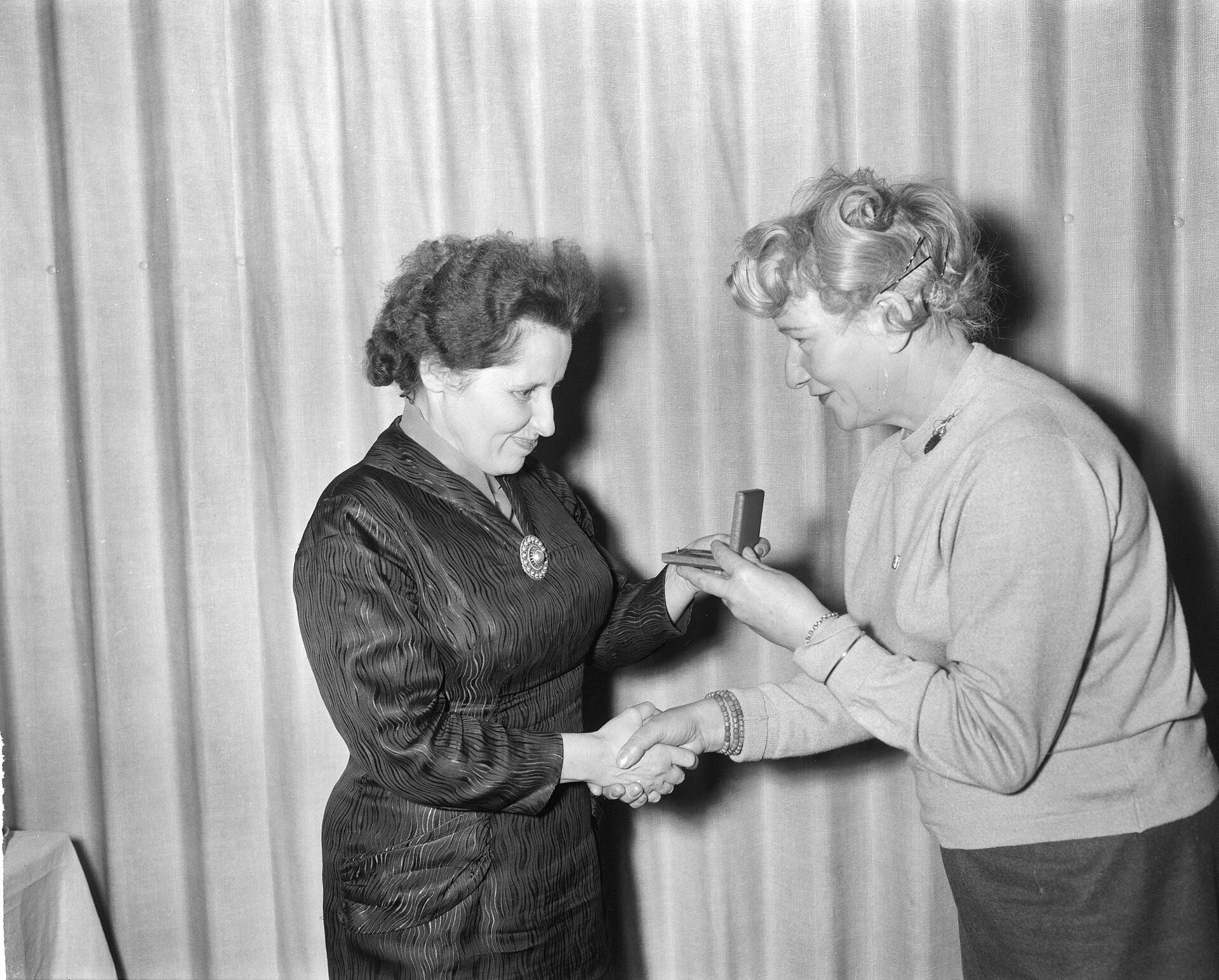
Joop van Bilsen / Anefo
Introduction
Elisaveta Ivanovna Bykova (Елизавета Ивановна Быкова), also rendered as Elizaveta, Elisabeth, or Elizabeth Bykova, occupied a distinctive place in twentieth-century chess. She was the third Women's World Champion, holding the title from 1953 to 1956 and again from 1958 to 1962. She was the first woman to regain the world championship after losing it. Her record also included three Soviet championships, six Moscow championships, victory in the first Women's Candidates Tournament, and the open International Master title. These achievements alone place her among the leading competitors of her era. Her wider historical importance rests equally on sustained work as an author, journalist, lecturer, editor, and television educator.
Even the basic biographical record requires care. Most chess reference works give 4 November 1913 as Bykova's birth date. In 2013, however, researchers in the State Archive of Vladimir Region located a parish metric-book entry recording that she was born and baptized in Bogolyubovo on 19 September Old Style, or 2 October New Style. The entry names her parents as the peasants Ioann, commonly Ivan, Evdokimovich Bykov and Varvara Yakovlevna. A second Elisaveta recorded on the same page may explain the long-standing error. The archival discovery strongly favors 2 October 1913, although published authorities have not uniformly revised the traditional date. This profile therefore records both. (Russian Chess Federation archival notice; Vladimir regional account)
Early Life and Chess Formation
Bykova was born in Bogolyubovo, near Vladimir, into a peasant household. She completed four classes at the village school. About 1925 she moved to Moscow. Russian biographical accounts usually identify the relative with whom she lived as her older brother Vasily, who introduced her to chess. In 1927, as the only girl in her school tournament, she finished first. This precocious result did not lead immediately to a professional chess path. Her development was gradual and remained connected to education and salaried work.
Russian biographical accounts place her first in a planning and economics technical school and later at the Institute of National Economic Accounting. She worked in Moscow's Central Administration of National Economic Accounting, usually abbreviated in Soviet sources as TsUNKhU. The exact tertiary credential is not uniform across the surviving accounts. Her economics and statistics training supplies useful context for the patient bibliographic and organizational work that later became a substantial part of her chess career. The connection is interpretive; no source located for this profile states that the training directly determined her methods. (Yuri Kornilov's Russian biographical study, preserved in a regional historical collection; Big Russian Encyclopedia)
The decisive stimulus came from the Moscow International Tournament of 1935. Bykova attended the event and saw the reigning world champion Vera Menchik, whose example demonstrated that a woman could build an international chess career. She subsequently studied in organized women's chess schools associated with the newspaper 64 and the chess club of the All-Union Central Council of Trade Unions. Her own reminiscence, preserved in a Russian regional biography, names A. Iglitsky and Yakov Rokhlin as instructors who taught theory, analysis, and positional understanding. This combination of public chess culture, structured instruction, and regular competition converted a talented school player into a serious Moscow competitor.
Her early progress was steady. In 1937 she placed third in the Moscow women's championship. From 1938 to 1952 she won that championship six times. A revealing milestone came in 1944, when her performance in a quarterfinal section of the men's Moscow championship earned her the Soviet first-category classification. The episode is useful because it shows that her strength was tested within the broader Moscow chess system, even though most of her major titles came in women's events. (Russian Chess Federation profile; Vladimir regional account)
Rise in Competitive Chess
The Second World War interrupted normal tournament life and revealed Bykova's public conception of chess. Russian federation and FIDE accounts identify her as the initiator of a program through which women chess players supported military hospitals. She lectured, held discussions, organized events, and gave simultaneous exhibitions for wounded servicemen. A contemporary report by Vladimir Alatortsev in Shakhmaty v SSSR placed her among chess workers in Sverdlovsk who combined industrial employment with hospital service. It credited her, over eighteen months, with conducting 52 qualification tournaments in which 223 wounded servicemen earned Soviet chess categories. These near-contemporary figures substantiate the later summaries. The evidence identifies Bykova as a chess organizer and industrial worker, not as medical staff. (Alatortsev, "Патриотическая инициатива советских шахматистов," Шахматы в СССР, 1945 no. 1, pp. 11-12; Russian Chess Federation profile)
Bykova reached national preeminence soon after the war. She won the Soviet Women's Championship held from December 1946 to January 1947 with 14 points from 16 games. She retained the national title in the championship held from December 1947 to January 1948, scoring 12 from 15, then won again at Riga in 1950 with 12.5 from 15. The first two events explain a common disagreement in reference works. Soviet lists generally call her champion in 1947, 1948, and 1950, using the finishing year; FIDE summaries often print 1946, 1947, and 1950, using the starting year. Describing the tournaments as the 1946/47 and 1947/48 championships gives the clearest record. (1946/47 championship record; 1947/48 championship record; 1950 championship record)
Her results were not uniformly dominant. In the 1948/49 Soviet championship she finished in the lower half of the field. The emphatic 1950 victory was therefore a recovery as well as a third title. This unevenness helps explain a feature later emphasized by Nona Gaprindashvili: Bykova's temperament was especially effective in matches, where she could study one opponent closely and adjust her strategic plan over a long contest. (1948/49 championship record)
The world championship tournament of 1949/50 offered her first opportunity at the title left vacant after Menchik's death. Bykova scored 10 from 15 and shared third and fourth places, half a point behind Olga Rubtsova and a point and a half behind the winner, Lyudmila Rudenko. She had not yet separated herself from the close group of elite Soviet players. Her subsequent advance came through the new qualification system. At Moscow in 1952, she won the first Women's Candidates Tournament with 11.5 from 15, a full point ahead of Olga Ignatieva and Fenny Heemskerk. The victory earned a direct match with Rudenko and established Bykova as the leading challenger. (1949/50 event record; FIDE Museum profile; 1952 Candidates record)
Major Career Achievements
The 1953 Championship Match
The 1953 match in Leningrad became the central competitive turning point of Bykova's career. Rudenko won the first two games. Bykova recovered, led 4.5 to 2.5 after seven games, and then saw the score levelled at 5 to 5. She won three of the final four games and took the match 8 to 6, with seven wins, five losses, and two draws. The result displayed the qualities that would define her reputation: emotional control after a poor start, stamina, close preparation, and an ability to impose a technical struggle across repeated encounters. Mikhail Yudovich served as her second for the match. Efim Kogan, identified in Russian sources as her regular coach through much of the 1950s, helped shape the analytical method behind her strongest period. (1953 match record; Russian Chess Federation profile)
Bykova became the third Women's World Champion. In the same year she received the Soviet title Honoured Master of Sport and FIDE's open International Master title. The latter distinction should be stated precisely. She was awarded Woman International Master in 1950, International Master in 1953, and Woman Grandmaster in 1976. She was not an open grandmaster. (FIDE Women profile; Big Russian Encyclopedia)
Loss and Recovery
The title changed hands in an unusual three-player event in Moscow in 1956. Bykova, former champion Rudenko, and Candidates winner Rubtsova each played eight games against both opponents. Rubtsova scored 10 from 16; Bykova finished half a point behind; Rudenko scored 4.5. Bykova led by half a point before the final round, when she had the scheduled bye. Rubtsova defeated Rudenko and passed her. The format was never repeated for the women's world title. Bykova lost the championship by the narrowest possible margin in a long multi-player event. There was no direct match. (OlimpBase event record)
The return match with Rubtsova in Moscow in 1958 produced Bykova's most striking recovery. She trailed 2 to 4 after six games, then won six consecutive games. A draw in game fourteen completed an 8.5 to 5.5 victory. She thereby became the first woman to regain the world championship. The six-game run needs no move-by-move analysis to explain its historical importance. It showed that her patient style could coexist with sustained competitive force when the match demanded it. (1958 match record; FIDE Museum profile)
Bykova successfully defended the title against Kira Zvorykina in Moscow from December 1959 to January 1960. The match remained close through nine games. Bykova then won games ten, eleven, and twelve, and secured the title with a draw in game thirteen. Her final score was 8.5 to 4.5, with six wins, two losses, and five draws. She reinforced this standing in 1960 by winning an international women's tournament in Amsterdam ahead of Milunka Lazarević and Chantal Chaudé de Silans. (1959/60 match record; Russian Chess Federation profile)
Her reign ended in Moscow in 1962 against the 21-year-old Nona Gaprindashvili. Bykova was nearly 49 when the match began and, if the archival birth date is accepted, turned 49 during it. Gaprindashvili won 9 to 2, with seven victories and four draws. The score signaled a generational change in elite women's chess, including a sharper standard of dynamic play and systematic preparation. It should not be used to reduce Bykova's earlier record. She had already spent more than fifteen years at the top of Soviet competition and had won three world title matches during two separate reigns. At the closing, Bykova gave Gaprindashvili a copy of her Vera Menchik biography inscribed to the continuer of Menchik's traditions. The gesture expressed mutual respect and Bykova's sense of championship history. She returned once more to the Candidates tournament in 1964, then continued to appear in Moscow events into the late 1970s. In the 1970s she played first women's board for the Moscow Economic-Statistical Institute in city team competition. (FIDE world champions overview; Gaprindashvili's memoir chapter "Правила игры"; Big Russian Encyclopedia)
Bykova also represented the Soviet Union in bilateral matches against teams from Britain, Yugoslavia, East Germany, and Czechoslovakia. She did not play in a Women's Chess Olympiad, despite occasional online claims to the contrary. Her international team career belonged to the bilateral match culture of the 1950s and early 1960s. (Russian Chess Federation profile; OlimpBase, 1957 Soviet team record)
Style and Reputation
The most informative contemporary assessment comes from Gaprindashvili's 1977 memoir, Predpochitayu risk (I Prefer Risk). She described Bykova as exceptionally composed, patient, industrious, and persistent. Bykova preferred positions in which she could maintain pressure without taking unnecessary risk. Against tactically inclined opponents, she often chose simplifying schemes and steered play toward endings. Gaprindashvili considered her superior to her peers in simple positions and endgames. She also stressed Bykova's opponent-specific preparation, including the search for a psychological approach suited to each rival. The familiar quotation claiming that she "had no equal" joins phrases from several passages in Gaprindashvili's chapter, so it is treated here as a later composite and is not quoted as a continuous contemporary statement. (Russian text of Gaprindashvili's memoir chapter)
This account gives more substance than the generic label "positional player." Bykova accumulated small advantages, waited for structural concessions, and recognized an opponent's positional errors quickly. She worked seriously on opening theory and endings. Her defensive persistence was equally notable. Gaprindashvili recalled that she continued to search for resources in positions others might abandon and sometimes saved half-points through sheer tenacity. These traits made her especially formidable over a match, where preparation and emotional steadiness had cumulative effects.
Mikhail Beilin's recollection adds a colleague's view of her working habits. He remembered her as exceptionally modest and industrious, and noted that she remained at the board while her opponents thought. He also recalled Yuri Averbakh advising her to concentrate on endgame study, after which that phase became a conspicuous strength. The account supports the image of Bykova's technique as acquired through disciplined study. (Beilin, "Автографы")
Her preference for controlled positions also defined the boundary of her method. When an opponent prevented simplification and imposed a faster, highly dynamic struggle, Bykova could be denied the conditions in which she was most authoritative. This interpretation is drawn from her match practice and Gaprindashvili's description. No contemporary source located for this profile states it directly. The 1962 result cannot isolate style from age, form, and the training advances represented by the next generation.
Bykova's reputation among leading Soviet players rested on professional seriousness. Spectacle was secondary. Her strongest games often appeared deceptively quiet. Pressure accumulated through maneuver, accurate exchanges, and endgame judgment. Her world championship record shows a competitor capable of recovering inside a match: after losing the first two games in 1953, after surrendering the title by half a point in 1956, and after falling two points behind Rubtsova in 1958. This repeated recovery gives the clearest guide to her historical reputation. A single combination or opening novelty cannot do so.
Contributions Beyond Tournament Play
Bykova was one of the earliest major historians of women's chess in the Soviet Union. Her Sovetskie shakhmatistki: K istorii zhenskikh shakhmatnykh sorevnovanii (Soviet Women Chess Players: Toward a History of Women's Chess Competitions) first appeared in 1951. A substantially enlarged edition followed in 1957. In her preface, Bykova observed that chess literature had yet to devote a full work to women players and set out to synthesize Soviet women's competitions since 1925. The book combined tournament records, biographical notices, and an institutional history of women's competition. It preserved information about many regional and national players who received little coverage elsewhere. Like any Soviet sports publication of its period, it reflects official language and institutional priorities. Used critically, it remains an important historical source as well as evidence of Bykova's effort to give women chess players a documented past. (Digital text of Bykova's 1951 edition)
She published Sorevnovaniya na pervenstvo mira po shakhmatam sredi zhenshchin (Competitions for the Women's World Chess Championship) in 1955 and Vera Menchik: Pervaya chempionka mira po shakhmatam (Vera Menchik: The First World Chess Champion) in 1957. The Menchik biography had particular significance. Bykova had seen Menchik in Moscow in 1935; two decades later, she reconstructed the career of a champion killed in London in 1944 and reintroduced her achievement to a Soviet readership. Nikolai Sakharov's bibliography records that G. N. Lagovsky collaborated on the biographical text and contributed the section on Menchik in the Soviet Union, a role often absent from brief publication lists. Bykova also compiled Shakhmatnyi ezhegodnik. 1960 (Chess Yearbook 1960), published in 1962, a large editorial undertaking that surveyed major events, annotated games and endings, correspondence chess, composition, and chess literature. (Russian State Public Library for Science and Technology bibliographic exhibition; Sakharov's Шахматная литература России, 1775-1997; National Mining University digital catalogue record for the 1960 yearbook)
Her journalism and educational work extended the same documentary impulse. Russian sources credit her with editing the chess section of the magazine Kulturno-prosvetitelnaya rabota (Cultural and Educational Work). She also helped organize and conduct the Central Television program Shakhmatnaya shkola (Chess School). Launched in 1969, the program combined broadcast lessons with correspondence assignments. Retrospective accounts describe Bykova handling viewers' answers and helping administer the instructional process; several call her the school's director. In this context the title describes an administrative and pedagogical coordinator, not necessarily the principal on-screen lecturer. This was structured distance education with regular viewer exercises. It brought serious chess instruction to viewers far from established clubs. (Russian Chess Federation retrospective; Sport-Strana biographical record; history of the Soviet television program)
No firm evidence supports presenting Bykova as a career trainer or professional second. Her pedagogical legacy took a different form: books, reference compilation, lectures, wartime hospital work, journalism, and television instruction. Together these activities widened access to chess and preserved the history of women who had participated in it.
Later Life and Historical Legacy
Bykova's active career belonged wholly to the Soviet period. She died in Moscow on 8 March 1989 and was buried at Khovanskoye Cemetery. Her honors included Honoured Master of Sport of the USSR in 1953 and the Order of the Badge of Honour in 1957. FIDE awarded her Woman International Master in 1950, open International Master in 1953, and Woman Grandmaster in 1976, the inaugural year of the latter title. (Big Russian Encyclopedia; FIDE Women profile)
She maintained a personal connection with the Vladimir chess community. When the Vladimir city chess club opened in 1966, Bykova sent two of her world-champion laurel wreaths for display there. The gift linked her international distinction to a local institution in the region of her birth. (Vladimir regional account)
Post-Soviet commemoration has clarified and broadened her record. FIDE designated 2013 the Year of Elizaveta Bykova, and the World Chess Hall of Fame inducted her that year. In 2017 the secondary school in Bogolyubovo was named for her and a memorial plaque was unveiled. The Vladimir region has also hosted memorial events. The discovery of her parish birth record in the centenary year improved the historical record. (FIDE commemorative announcement; World Chess Hall of Fame; Vladimir regional report on the 2017 dedication)
One material link to her championship survives in Moscow's Chess Museum. The Hamilton-Russell Cup, the original trophy associated with the women's world championship, passed from Vera Menchik to Rudenko, Bykova, Rubtsova, and back to Bykova. A new trophy accompanied Gaprindashvili's reign. Bykova was therefore the last champion to regain and hold the original cup during its active championship history. (Russian Chess Federation Chess Museum)
Historical Assessment
Elisaveta Bykova deserves attention today as the leading women's match competitor of the 1950s and as a builder of chess culture beyond the tournament hall. Her three Soviet titles, victory in the first Candidates tournament, two world championship reigns, and successful title defense establish the competitive record. Her books preserved a history that was still poorly documented; her lectures, journalism, hospital work, and television teaching carried chess to audiences outside elite competition. The combination explains her durable significance. Her championship reigns formed one part of a larger contribution. She helped create the historical memory, educational practice, and competitive standards through which women's chess in the Soviet Union understood its own development.
Notes and Sources
State Archive of Vladimir Region birth record, summarized by the Russian Chess Federation and discussed in the Vladimir newspaper article "Столетие Елизаветы Быковой". These are the basis for preferring 2 October 1913 to the conventional 4 November date.
Yuri Kornilov, "Чемпионка мира из Боголюбова," reproduced in a regional historical collection. This detailed Russian biography is particularly useful for Bykova's schooling, employment, early chess instruction, and Moscow development. Some family details in later popular biographies remain difficult to verify independently.
Russian Chess Federation, "Елизавета Быкова". Useful for the six Moscow championships, international team matches, wartime work, Amsterdam 1960, television activity, and the overall career outline.
Big Russian Encyclopedia, "Быкова Елизавета Ивановна". A concise scholarly reference for education, Soviet and FIDE titles, major results, coaching, later competition, and death.
The exact records of the 1946/47, 1947/48, and 1950 Soviet championships are cross-checked in the event pages linked in the text. The differing year conventions explain the inconsistent title dates found in modern reference works.
FIDE Open Chess Museum, "Elisaveta Bykova" and the FIDE Women profile. These confirm the world championship sequence and FIDE titles. The Women profile contains a faulty 1952 Candidates score line, so the tournament total in this article follows the event record.
Nona Gaprindashvili, Предпочитаю риск (Moscow: Molodaya Gvardiya, 1977), chapter "Низкий поклон ветеранам," available in Russian transcription. This is the principal contemporary source for Bykova's style, work habits, match temperament, and reputation.
R. Bilunova and S. Rosenberg, "Могучее трио чемпионок". A specialist Russian historical essay on Rudenko, Bykova, and Rubtsova, useful for Soviet championship culture, coaching, and later recollections.
E. I. Bykova, Советские шахматистки: К истории женских шахматных соревнований (Moscow: Fizkultura i sport, 1951; enlarged edition, 1957); Соревнования на первенство мира по шахматам среди женщин (Moscow: Fizkultura i sport, 1955); and Вера Менчик: Первая чемпионка мира по шахматам (Moscow: Fizkultura i sport, 1957). Bibliographic details are also gathered in the Russian State Public Library for Science and Technology exhibition.
E. I. Bykova, compiler, Шахматный ежегодник. 1960 (Moscow: Fizkultura i sport, 1962). See the National Mining University digital catalogue.
FIDE, "2013: Year of Elizaveta Bykova" and the World Chess Hall of Fame induction profile.
Russian Chess Federation Chess Museum, "Громокипящие кубки", for the Hamilton-Russell Cup's succession and museum history.
Vladimir Alatortsev, "Патриотическая инициатива советских шахматистов," Шахматы в СССР, 1945 no. 1, pp. 11-12. This contemporary report is the strongest located evidence for the scale and institutional form of Bykova's hospital chess work.
Mikhail Beilin, "Автографы", published posthumously in Здравый смысл, 2010 no. 2. A colleague's recollection of Bykova's modesty, concentration, training practices, and endgame development.
Nikolai I. Sakharov, Шахматная литература России, 1775-1997 (Moscow: Sovetskii sport, 2001). Used to verify editions, print data, the scale of the 1960 yearbook, and G. N. Lagovsky's contribution to the Menchik biography.
