Svetozar Gligoric
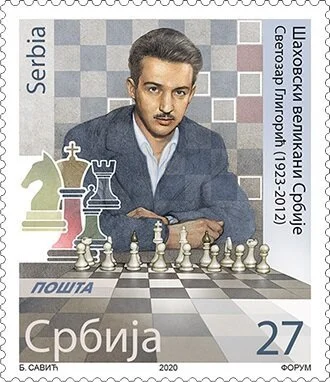
B. Savic, Post of Serbia
Introduction
Svetozar Gligorić (Serbian Cyrillic: Светозар Глигорић; Russian: Светозар Глигорич; often written without the diacritic as Gligoric) occupied a distinctive place in twentieth-century chess. Born in Belgrade on 2 February 1923, he became the leading player of postwar Yugoslavia, reached the world championship Candidates stage three times, and represented his country in fifteen Olympiads. For much of the 1950s and 1960s, he was among the strongest players outside the Soviet Union and the first-board figure of the most persistent non-Soviet team challenger. His significance also rests on a wider body of work: rebuilding chess institutions after the Second World War, explaining elite chess through print and radio, shaping several major openings, contributing annotations to Russian-language tournament books alongside Soviet colleagues, and serving in senior arbitral and federation roles. [4, 5]
Gligorić's title I Play Against Pieces expressed a principle associated with him by contemporaries. He approached chess as a contest of ideas and positions, with personal hostility kept outside the game. The phrase can sound modest, although his play was often ambitious and combative. FIDE's fair-play trophy now carries his name. [8, 11]
Early Life and Chess Formation
Gligorić was an only child born into a family of limited means in Belgrade. His father died when Svetozar was about eight or nine. His mother supported the household in difficult circumstances and died on 1 November 1940, leaving him orphaned at seventeen. Gligorić later recalled being fascinated by a chess set displayed near a café when he was about eight, learning the game around age eleven, and studying newspaper columns and chess books before entering organized youth competition at thirteen. This staged account reconciles sources that give either eleven or thirteen as the age at which he "began" chess. [1, 15]
He attended Kralj Petar I Primary School and the First Boys' Gymnasium (Prva muška gimnazija) in Belgrade, completing his school-leaving examination in Kotor in 1941. After liberation, he briefly registered for technical studies. He later completed the first year of English studies at the University of Belgrade with high marks, then left because a combined life in tournament chess and journalism had become a profession. His language ability later proved unusually useful. He reported internationally in English and Russian and could address audiences across the principal chess divide of his era. [2, 3, 15]
The Belgrade Chess Club provided his decisive early environment in chess. He won a club competition in 1938 and took first place in the 1939 Yugoslav Amateur Championship in Zagreb, where the club helped finance his journey, and the organizers covered his accommodation. The result brought master status and entry into stronger national competition. After his mother's death, three households offered to support him. He chose the family of Dr Niko Miljanić, chairman of the Belgrade Chess Club, a relationship that joined personal rescue with chess patronage. [1, 2, 15]
War then interrupted his development at the point when a gifted European player would ordinarily have entered international competition. Miljanić's family left Belgrade for Vrnjačka Banja shortly before the Axis bombing of April 1941 and later moved to Montenegro. Gligorić's recollection of this period includes physical work in Miljanić's hospital, self-taught bookkeeping, and typing material from a French medical encyclopedia. He joined the Yugoslav Partisans in 1943. By the end of the war, he held the rank of captain and had received two decorations. These facts are documented in his testimony; claims about the experience forming a particular chess temperament remain interpretation. Four central developmental years disappeared from his competitive record. [1, 4, 15, 16]
Rise in Competitive Chess
Gligorić returned to chess immediately after liberation. He recalled helping to organize the first postwar Yugoslav championship, in which he finished second. In 1947 he shared his first national championship and scored 8 points from 9 at Warsaw, finishing ahead of Vasily Smyslov and Isaac Boleslavsky. Warsaw was a concise announcement that the wartime interruption had delayed his career without closing it. FIDE awarded him the International Master title in 1950 and the Grandmaster title in 1951. [1, 4, 22]
He eventually won eleven Yugoslav championships, beginning in 1947 and extending into the mid-1960s. The total deserves a bibliographical caution. Several later obituaries and commemorative pages give twelve, while the reconstructed championship record, the Srpska enciklopedija, and the Russian Chess Federation give eleven. Eleven is therefore the safer figure. His major international results were geographically wide: outright victories at Mar del Plata in 1950 and 1953; five first-place finishes or shares at Hastings; a tie with Samuel Reshevsky at Dallas in 1957; and first or shared first at Lone Pine in 1972 and 1979. This selection conveys his range without turning the profile into a tournament inventory. In 1958 the newspaper Sport named him Yugoslavia's sportsman of the year, a measure of his status beyond specialist chess circles. [4, 16, 21, 24]
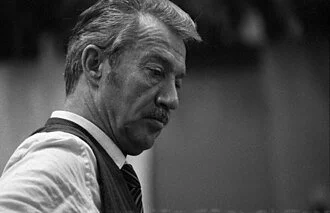
Svetozar Gligoric at the Chess Olympiad Luzern, Switzerland, 1982. KRTschil
Major Career Achievements
Yugoslavia's Olympiad First Board
The Olympiads provide the clearest measure of Gligorić's public role. He played in fifteen Olympiads between 1950 and 1982, thirteen of them on first board. Yugoslavia won team medals in twelve of those appearances: gold in 1950, six silvers, and five bronzes. The 1950 victory at Dubrovnik came while the Soviet Union and several Eastern European teams were absent. Its domestic importance was considerable, and the later medal sequence showed sustained strength. Once the Soviet team entered regularly, Yugoslavia became its most consistent Olympiad pursuer. [5]
Gligorić's strongest individual result at the Olympics came in Munich in 1958. He scored 12 from 15 without a loss and won the individual gold medal on first board, ahead of world champion Mikhail Botvinnik's percentage. The achievement combined individual form with the burden of meeting every opponent's leading player. His three decades as Yugoslavia's principal representative did as much as his tournament victories to establish his standing at home. [4, 5]
The World Championship Cycles
Gligorić reached the Candidates stage in 1953, 1959, and 1968. After failing to qualify from the 1948 Interzonal, he made his Candidates debut at Zürich in 1953, aged thirty. His strongest cycle began at the 1958 Portorož Interzonal, where he finished second, only half a point behind Mikhail Tal. At the 1959 Candidates Tournament, played in Bled, Zagreb, and Belgrade, he shared fifth and sixth places with Bobby Fischer. The top four finishers were Tal, Paul Keres, Tigran Petrosian, and Vasily Smyslov. [4, 6, 9]
He qualified again at Sousse in 1967 by sharing second through fourth place, remaining undefeated over twenty-one rounds. The result led to his only direct Candidates match, against Tal in Belgrade in 1968, with Dragoljub Velimirović assisting him. Gligorić won the first game and led 3-2 after five; Tal scored 3.5 points from the final four games and won 5.5-3.5 after nine. In a 2007 interview, Gligorić retrospectively identified his unplanned departure from preparation in game six as the turning point. At forty-five, he had returned to the Candidates quarterfinal stage after nearly a decade. [7, 18, 20]
His record in the cycles documents repeated access to the championship elite in different formats over fifteen years. The interruption of his youth, the depth of the Soviet field, and his increasingly familiar repertoire all affected the path. The span of his three qualifications demonstrated exceptional durability. He remained prominent after 1968, appearing for the Rest of the World against the USSR in Belgrade in 1970 and continuing to win strong international events well into later life. [4, 9]
Between Soviet and International Chess Cultures
Gligorić's career unfolded in unusually close contact with Soviet chess while Yugoslavia pursued an independent socialist course. He met Soviet grandmasters constantly in Olympiads, zonal and Candidates events, bilateral matches, and tournaments. To Soviet readers he became a familiar rival, analyst, and author. Reviewing the 1959 Candidates Tournament in Shakhmaty v SSSR, Alexander Kotov wrote that Gligorić had again proved himself "one of the strongest chessplayers of the West," using the journal's period vocabulary for a Yugoslav grandmaster. [17] The Russian Chess Federation's retrospective later emphasizes his opening preparation, technical skill, and universal style, while Soviet publishing placed his work in a series devoted to the world's outstanding players. [4, 12]
The 1959 Candidates Tournament offers a revealing example. A Russian-language tournament book published by the Yugoslav Chess Federation in 1960 featured game annotations by Gligorić and Soviet grandmaster Viacheslav Ragozin. Gligorić also supplied annotations to the Russian-language Bled 1961 tournament book, published in Ljubljana in 1962. These books made a Yugoslav participant's analysis available to Russian-speaking readers and show that serious chess exchange crossed institutional and political lines at the level of working literature. [6]
His later appointments confirmed the trust he commanded across federations. He became an international arbiter in 1972, served as chief arbiter for the 1983 Candidates match between Garry Kasparov and Viktor Korchnoi, and held the same office during the first Karpov-Kasparov world championship match in 1984 and 1985. He also stood for the FIDE presidency in 1978. In the first ballot he received 29 votes, one fewer than Friðrik Ólafsson and two fewer than Narciso Rabell Méndez; Ólafsson won the subsequent runoff. In retrospect, Gligorić called the candidacy a mistake because he disliked federation politics. He said that one aim had been to restore Fischer to organized chess. [1, 4, 13, 19]
Style and Reputation
Gligorić is commonly described as a dynamic universal player. He could conduct technical positions with patience, yet his most characteristic games depended on active piece play, timely pawn breaks, and counterattack. In a late interview, he identified tempo as the central currency of chess. That emphasis clarifies his practical choices better than a label such as "attacking player." He sought positions in which activity could be accumulated move by move and converted into initiative. [1, 4]
His opening work was both practical and theoretical. In the King's Indian Defense, he helped establish the strategic and tactical vocabulary of the Mar del Plata system through his games in Argentina in 1953 and through later writing. The system took its enduring name from that event, especially his victory with Black over Miguel Najdorf. In his later monograph, Gligorić credited Aronin and the 1952 Taimanov-Bronstein game with the initial setup and identified his own plan as the decisive refinement. He also contributed to the Ruy Lopez, Nimzo-Indian Defense, Grünfeld Defense, and the study of rook endings. His opening books were written from a practitioner's perspective: recurring structures, plans, and decisions received more attention than encyclopedic completeness. [1, 4, 9, 25]
At the highest level, loyalty to a compact Black repertoire reduced surprise and made targeted preparation easier. Leonard Barden later argued that this predictability became a strategic exposure. Repeated practice produced unusual expertise in the positions Gligorić chose. Repertoire breadth is therefore a poor proxy for his chess strength. His results show that his understanding often carried familiar openings well beyond the reach of preparation. [4, 9]
His reputation for sportsmanship was equally durable. I Play Against Pieces described an impersonal competitive ethic joined to strong ambition. Aleksandar Matanović, his colleague and friend for more than six decades, remembered the steadiness of that character at the 2023 Belgrade centenary observance. Fischer also retained a long personal trust in him. During preparations for Fischer's 1992 return match with Spassky, the two played ten private training games, the score sheets of which were later documented by Edward Winter. This was a private training arrangement and evidence of confidence between two very different chess personalities. [8, 10]
Contributions Beyond Tournament Play
Gligorić's public work began alongside his postwar playing career. He helped revive city and national competition, was among the founders and the first secretary of the Red Star Sports Society, and helped establish its chess club. His long club career then centered on Partizan, with which he was associated for thirty-eight years. These activities belong to the reconstruction of Yugoslav chess after occupation, and they help explain why his national reputation exceeded that of a successful traveling grandmaster. [1, 8, 16]
Journalism became his second profession. He worked for the daily Borba from 1946 to 1954, served as a foreign-affairs commentator for NIN from 1954 to 1960, and worked at Radio Belgrade from 1960 to 1978. In 1971, Radio Belgrade assembled a link among Belgrade, Moscow, and New York for a bilingual Russian-English radio exchange centered on Petrosian and Fischer. Radio Belgrade awarded him its Golden Microphone in 1972. In early 1973, Chess Life & Review printed interviews he had conducted for radio with Fischer, Spassky, and a leading Icelandic organizer. [2, 3, 10, 16]
As an author, Gligorić moved among tournament reporting, opening monographs, instructional essays, and annotated games. His books on the 1958 Interzonal and 1959 Candidates event preserved participant analysis. His rapidly produced account of the 1972 Fischer-Spassky match reached a large international readership, although the precise sales figures cited in later sources are not independently verified. His most substantial personal work was I Play Against Pieces, a collection of 105 annotated games framed by autobiography. The cataloged Russian edition appeared as Играю против фигур in Moscow in 1983, in the Soviet series Выдающиеся шахматисты мира; Serbian and English editions followed in 1989 and 2002. The title summarized his ethics, while the annotations recorded how he evaluated positions before computer analysis became standard. [6, 9, 10, 12, 16]
His documented instructional influence was primarily public: books, columns, broadcasts, lectures, and the example of a coherent opening repertoire. There is little evidence for a sustained career as a professional trainer or second. His teaching record is best documented in published analysis and explanation.
Later Life
In 1976 Gligorić withdrew from tournament chess for a year and declined nine invitations. He later explained that he had become dissatisfied with professional play, then returned in 1977 because he needed the income. He did not claim to have recovered his earlier form. The return still produced substantial results. At sixty-three he shared first place with Alexander Beliavsky and Rafael Vaganian in the 1986 Chigorin Memorial at Sochi, and at eighty he competed in the 2003-04 Rilton Cup. In 2007 he played Viktor Korchnoi in a veterans' match between representatives of the former Yugoslavia and Soviet Union. [1, 4, 23]
Gligorić married Danica in 1947; the marriage lasted until her death in 1994. They had no children. After her death he returned to the piano. In 2002 and 2003 he undertook formal study of harmony and later learned music software. The resulting twelve-track album, Kako sam preživeo XX vek (How I Survived the Twentieth Century), was released in 2011 and drew on jazz, popular music, and rap. Gligorić described composition as another form of creative work. [1, 2, 9, 15]
Gligorić died in Belgrade on 14 August 2012, aged eighty-nine, after a stroke. [4, 14]
Historical Legacy
Three parts of Gligorić's legacy are especially durable. The first is institutional. He gave Yugoslav chess a recognizable first board across three decades and helped convert a postwar national revival into sustained international standing. The second is intellectual. His opening practice, tournament books, and autobiographical annotations remain primary evidence for how an elite grandmaster outside the Soviet system absorbed, tested, and helped circulate the period's leading ideas. The third is ethical. His insistence on treating the game as a struggle with the position became part of his public identity, and FIDE's fair-play award in his name has given that identity an institutional afterlife. [5, 8, 11]
Gligorić's historical record spans eleven national championships, three Candidates qualifications, twelve Olympiad team medals, first-board gold, major theoretical work, trusted service as arbiter, and a substantial journalistic archive. He was central to the chess culture of a country that repeatedly tested Soviet supremacy while remaining open to the wider international circuit.
Notes and Sources
Maria Manakova, "Svetozar Gligorić: 'Life Is the Most Valuable Thing We Have'" (Russian), ChessPro, 2012. A posthumously published feature based on Manakova's interview and conversation with Gligorić the previous year. It supplies primary testimony with editorial framing on orphanhood, Dr Niko Miljanić, wartime service, career choices, style, FIDE politics, Fischer, and late musical work.
"Svetozar Gligorić, šahovski velemajstor" (Serbian), NIN archive. An archival questionnaire republished online in 2023, with the original interview date unspecified. Its primary biographical answers cover schools, university study, journalism, marriage, and family; the accompanying editorial medal totals should be checked against specialist records.
Radio Television of Serbia, "Svetozar Gligorić: šahovski velemajstor i sportski novinar" (Serbian). Useful for his work at Borba, NIN, and Radio Belgrade, including the 1971 international radio link. See also Radio Belgrade 1, "Svetozar Gligorić, šahista" (Serbian), on his broadcasting career and the Golden Microphone.
Russian Chess Federation, "Person of the Day: Svetozar Gligorić" (Russian). Concise career record, Candidates results, national titles, style, later tournament activity, and arbitral appointments.
OlimpBase, Svetozar Gligorić's Men's Chess Olympiad record. The specialist source for fifteen appearances, game totals, board assignments, and team and individual medals.
Douglas Griffin, "The Candidates' Tournament of 1959, with annotations by Gligorić and Ragozin". Uses the Russian-language tournament book and contemporary annotations; also see Griffin's Bled 1961 archival feature.
Douglas Griffin, "The Gligorić-Tal Candidates Quarter-final, Belgrade 1968". A reconstruction based on annotations by the players and contemporary Soviet and Yugoslav material.
FIDE, "The centenary of the birth of Svetozar Gligorić celebrated in Belgrade", 2023. Includes evidence on Partizan, Aleksandar Matanović, Gligorić's standing in Yugoslav chess, and the centenary commemoration.
Leonard Barden, "Svetozar Gligoric obituary", The Guardian, 22 August 2012. Particularly useful for style, repertoire, authorship, late career, and the timing of his world championship opportunities.
Edward Winter, "Svetozar Gligorić", Chess Notes, an archival collection of contemporary photographs, publications, and correspondence. See also Winter's documentation of the 1992 Fischer-Gligorić training games and his transcription notice for Gligorić's 1973 radio interviews.
FIDE, "Svetozar Gligorić Award for Fair Play". Official regulations and explanation of the award named for him.
Svetozar Gligorić, Igram protiv figura, WorldCat record; see also the Moscow library catalog record for Играю против фигур and the Open Library bibliography. For the 2002 English edition: I Play Against Pieces, translated by Biljana and Zoran Ilić, Batsford.
FIDE, "Friðrik Ólafsson (1935-2025)". Confirms the field and outcome of the 1978 FIDE presidential election.
Radio Television of Serbia, "Umro Svetozar Gligorić" (Serbian), 14 August 2012; and the Russian Chess Federation obituary, issued the same day. Contemporary institutional notices for his death and immediate assessment.
Ranko Pivljanin, "Svetozar Gligorić: Nisam želeo da budem svetski prvak" (Serbian), Blic, 6 March 2011; and Radoje Čolović, "Profesor dr Niko P. Miljanić" (Serbian Cyrillic), Project Rastko. The latter incorporates Gligorić's 2003 remembrance of Miljanić and supplies valuable detail on the wartime household.
Živko Baljkas, "Gligorić, Svetozar" (Serbian Cyrillic), Srpska enciklopedija, Book 1, Volume III, 2018. Strong on education, journalism, clubs, bibliography, and institutional roles, and consistent with eleven national titles. It dates the championship conventionally designated 1963 by its actual playing year, November 1962. It was not used uncritically for results: its IM year conflicts with formal FIDE title histories, it transposes Gligorić's Olympiad wins and draws, misstates his 1959 Candidates placing, and incorrectly attributes the 1964 Belgrade tournament to him.
Alexander Kotov, "Победа М. Таля" (Russian PDF), Шахматы в СССР, no. 1, January 1960, pp. 1-4; the quoted assessment is on p. 4. Contemporary Soviet coverage written immediately after the 1959 Candidates Tournament.
"Матчи претендентов: Глигорич-Таль" (Russian PDF), Шахматный бюллетень, no. 7, 1968, pp. 204-205. Contemporary Soviet publication of the nine game scores, match dates, and final score.
Henrik Malm Lindberg, "The Battle in Buenos Aires, 1978: A Three-Way Contest for the FIDE Presidency", FIDE Historical Committee, 5 August 2026. Reconstructs both ballots and corrects the repeated shorthand that Gligorić simply lost the presidency by one vote.
Russian Chess Federation, "Svetozar Gligorić: 'Tal was an actor in life'" (Russian), 17 November 2007. A first-person retrospective on Soviet visits, journalism, friendship with Tal, and Gligorić's preparation for their 1968 Candidates match.
OlimpBase, Svetozar Gligorić biographical record; and ChessBase, "To Gligoric with love: a legend turns 85", 2008. Both give the record total of eleven Yugoslav championships.
US Chess Federation, "Svetozar Gligoric". Used here for the formal title dates, International Master in 1950 and Grandmaster in 1951; its separate claim of twelve national titles is not followed.
Sochi 1986 crosstable, confirming the three-way first-place tie; ChessBase, "Svetozar Gligoric 1923-2012", for the Rilton Cup appearance at eighty; and ChessPro, the 2007 USSR-Yugoslavia veterans' match.
OlimpBase event records for Mar del Plata, Hastings, and Lone Pine; see also the Dallas 1957 crosstable. These confirm the selected tournament results without relying on later summary lists.
Svetozar Gligorić, King's Indian Defence: Mar del Plata Variation (Batsford, 2002). Gligorić's own retrospective account of the system's origins, development, and survival in high-level practice.
Historical Assessment
Svetozar Gligorić deserves attention today because his career reveals how a great chess culture could develop beside the Soviet system, contend with it repeatedly, and exchange ideas with it on equal professional terms. He gave Yugoslavia competitive authority, gave readers unusually lucid access to grandmaster thought, and left an example of ambition governed by intellectual fairness. His place in chess history rests on sustained excellence and on the institutions, literature, and standards of conduct that survived his playing peak.
