Emil Sutovsky
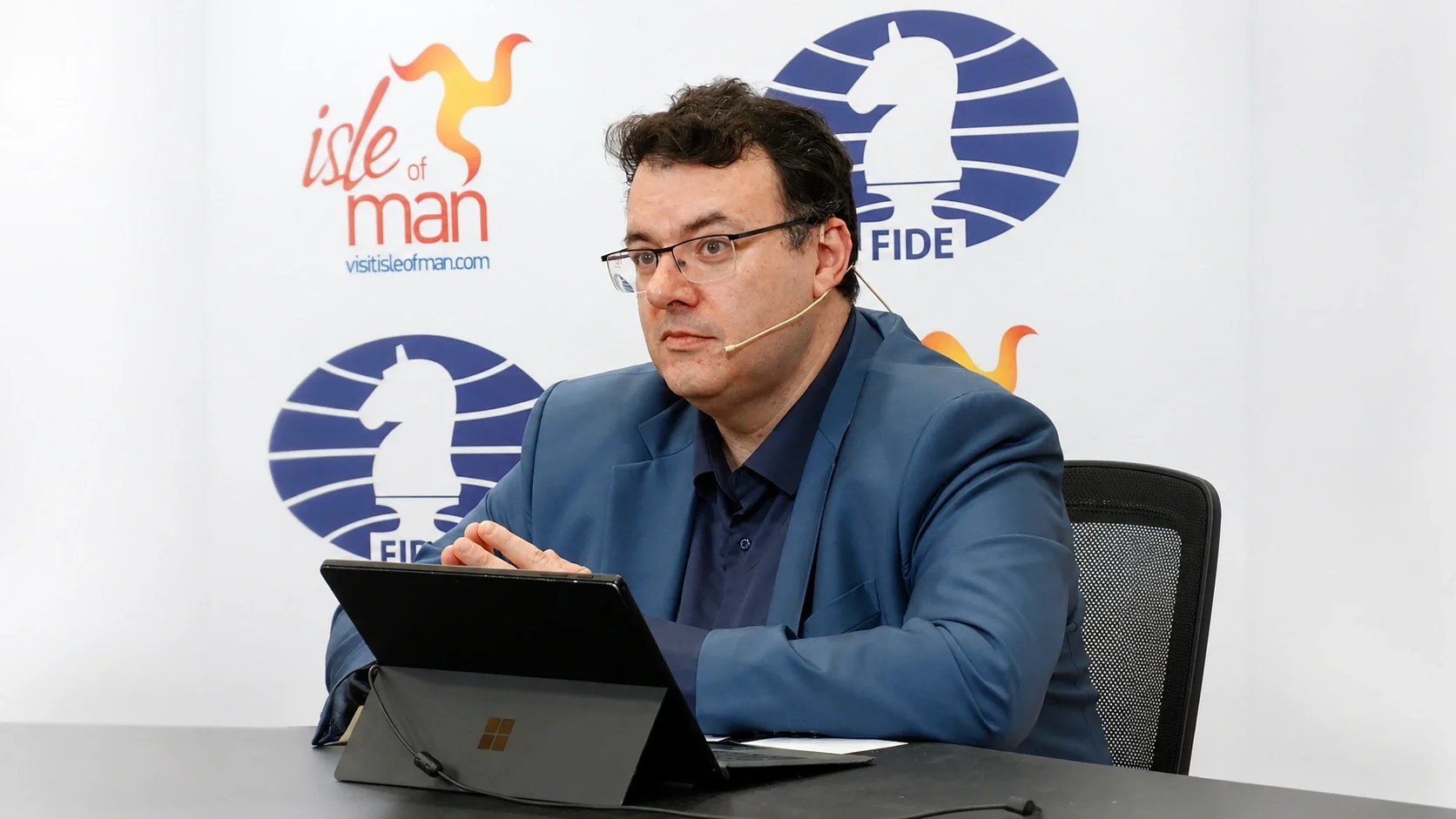
Photographed by Stefan64. Aspect ratio expanded
Introduction
Emil Davidovich Sutovsky, usually rendered in English simply as Emil Sutovsky, was born on September 19, 1977, in Baku, then in the Azerbaijan SSR. He became an International Master in 1993 and a Grandmaster in 1996, won the World Junior Championship in Medellín in 1996, captured the European Individual Championship in Ohrid in 2001, and later produced one of the finest Olympiad performances ever recorded when he scored 6.5 out of 8 on board two for Israel at Khanty-Mansiysk in 2010, with a 2895 performance rating and the individual gold medal on his board. Database and federation records place his classical peak at 2703 in January 2012, with a peak world ranking of number 17 in October 2004. In later years, he moved into high-level chess administration, serving as president of the Association of Chess Professionals in the 2010s, then as FIDE Director General from 2018 to 2022, and as FIDE Chief Executive Officer from 2022 onward.
Sutovsky deserves attention because his career joins several histories that are often studied separately. He belongs to the last generation formed in the Soviet chess environment, to the post-Soviet migration that strengthened Israeli chess in the 1990s, to the class of elite open-tournament specialists who reached the edge of the world top twenty without becoming world championship regulars, and to the later cohort of grandmasters who helped shape chess institutions, public discourse, and historical memory after their competitive peak. That combination gives him a profile far richer than a bare list of titles suggests.
Early Life and Chess Formation
Sutovsky learned chess at the age of four. Russian Chess Federation and Harvard Davis Center biographical sketches agree that he grew up in Baku, reached candidate master strength there, and moved with his family to Israel at age fourteen. In his own retrospective account, he stressed that the foundations of his chess came from his Soviet years, even though his adult career unfolded in Israel. He explicitly described the “Soviet Chess School” less as a fixed style than as a culture of serious, deep, and thoroughly professional preparation.
That biographical arc was historically typical of a wider demographic shift. Scholarly work by Mark Tolts on Jewish emigration from the former Soviet Union notes that during the great exodus surrounding the dissolution of the USSR, Israel became the first destination for the vast majority of emigrants leaving on Israeli visas. Sutovsky’s move in 1991 therefore belongs to a broader migration that transformed several Israeli cultural fields, chess among them. It is reasonable to interpret his later prominence as one especially successful expression of that larger movement.
Once in Israel, his progress was extremely fast. The Russian Chess Federation profile states that he soon won the Israeli Under-16 championship, became an International Master about a year and a half later, became a grandmaster at eighteen, and became World Junior Champion at nineteen. FIDE’s official player profile confirms the title dates of IM in 1993 and GM in 1996. On the educational side, official English-language federation profiles are sparse, yet Russian and Hebrew biographical summaries consistently state that he studied economics and management before elite chess success drew him more fully into a professional playing career. That point should be treated as a well-attested biographical summary rather than as a detail documented in a formal university record available online.
Rise in Competitive Chess
His first truly international breakthrough came with the 1996 World Junior Championship in Medellín. FIDE itself later referred to him as a former World Junior Champion, while OlimpBase’s historical listing records Sutovsky as the winner of the 1996 event. That title was significant because the World Juniors have long served as a sorting mechanism for future elite players. Winning it did not guarantee superstardom, yet it marked him as more than a strong émigré junior adapting to a new federation. It established him as a player of international consequence before his twentieth birthday.
A second phase followed in the late 1990s and early 2000s, when he proved that the junior title had not been an isolated peak. Harvard’s biographical note singles out his 1997 Hoogeveen success and his Hastings victory at the turn of the millennium, both of which helped establish him in the very strong European circuit of round-robins and open tournaments. Those victories placed him in the company of seasoned grandmasters and signaled that he was becoming a durable professional rather than a fleeting prodigy.
The true career turning point was the 2001 European Individual Championship in Ohrid. Chess-Results preserves the final crosstable, showing Sutovsky tied for first on 9.5 out of 13 ahead of a field that included Ruslan Ponomariov, Judit Polgár, Loek van Wely, and many others. Contemporary reporting from the event notes that he won the title after a playoff with Ponomariov. For an Israeli player in that period, and especially for one who was not among the pre-event favorites, this was a major continental triumph, arguably the result that fixed his standing in chess history.
Major Career Achievements
The Ohrid title was not an isolated summit. Sutovsky became one of the strongest and most dangerous players in the international open circuit. A FIDE tournament report and a contemporary ChessBase report show him winning the 2005 Aeroflot Open on tiebreak in a five-way tie for first with 6.5 out of 9, ahead of a field that included Vassily Ivanchuk, Alexander Motylev, Andrei Kharlov, and Vladimir Akopian. Aeroflot in those years was one of the hardest open tournaments in the world, and success there had real prestige because it required surviving a field with elite strength spread across many pairings rather than concentrated in a small invitational group.
His national-team record is central to any serious profile. Sutovsky was a long-serving member of the Israeli national side, and his 2010 Olympiad in Khanty-Mansiysk stands out as one of the greatest individual performances in modern team chess. ChessBase’s statistical overview recorded his 2895 performance rating as the best in the entire event, while OlimpBase’s medal summary lists him as the gold medalist on board two with exactly that figure. Contemporary reporting also noted that Israel finished third on tiebreak, with Sutovsky’s score as one of the decisive engines of the team’s bronze.
Later results confirmed his longevity. Harvard’s 2019 profile highlights victories at the 2015 Biel Masters Open, the 2016 Nona 75 ACP Open in Tbilisi, and the 2017 Karpov Tournament in Poikovsky. The Russian Chess Federation report on Poikovsky records a score of 7 out of 9 and first place on tiebreak. These are the achievements of a player who remained dangerous well past the age at which many tactical specialists decline sharply. His peak rating of 2703 in January 2012 and peak world rank of 17 in October 2004 show that he reached the outer edge of the world elite, even though he never crossed into the tiny group of regular Candidates.
Sutovsky was regarded as one of the world’s leading specialists in the Grünfeld and Sicilian defenses during the 2000s and 2010s. His opening contributions introduced original ideas into modern theory. He also holds positive classical scores against Magnus Carlsen, Vladimir Kramnik, and Fabiano Caruana.
Style and Reputation
Sutovsky’s reputation rests above all on the quality and character of his wins. In a substantial 2015 interview, Dorsa Derakhshani described him as a “brilliant tactician” and reported Levon Aronian’s view that he was the world’s strongest player in open positions. Sutovsky himself did not reject the basic characterization, though he explained his style as something largely natural, reinforced by a training habit of repeated exposure to difficult tactical and strategic exercises. The same interview shows how he thought about his own sacrificial play. He repeatedly emphasized intuition, feel, and long-term planning in sharp positions rather than sheer brute-force calculation to the end.
That self-description fits the games by which contemporaries remember him. ChessBase’s later discussion of the Gormally game records that Viswanathan Anand had called it one of the best games he had ever seen. In the 2015 interview, Sutovsky himself said that the final position of that Gibraltar 2005 win was “one of the happiest moments” of his life. The interview is also revealing because it shows one of the limits of his style: he freely admitted that the central sacrifice in that game might have been objectively refutable, yet it was so complex and practically difficult that neither player found the critical line over the board or in immediate post-mortem analysis. This is a useful clue to both his strength and his risk profile. Sutovsky was often at his most powerful in positions where practical complexity outweighed the need for clean, objective evaluation.
The other emblematic game is his 2002 win over Ilia Smirin. ChessBase later introduced it as perhaps his greatest game so far and as a masterpiece in miniature, emphasizing a bold two-piece sacrifice and a sustained attacking initiative. Sam Copeland, writing much later, still treated it as probably Sutovsky’s finest game and one of the best of the decade. Those retrospective judgments should not be confused with formal historical consensus, yet they do capture an enduring truth about his reputation: when chess writers sought to illustrate beauty, courage, and attacking imagination in the early twenty-first century, Sutovsky’s best games were repeatedly cited as examples.
His own sense of lineage was precise. When asked whether he was a modern-day Tal, he resisted the comparison. He accepted that the quantity of sacrificed material might invite it, but insisted the underlying style was different. That answer is characteristic. Sutovsky’s chess was romantic in effect, though less mystical than the Tal comparison implies. It was grounded in preparation, structural understanding, and practical decision-making amid high complexity, which closely aligns with his own description of the Soviet pedagogical legacy he inherited.
Contributions Beyond Tournament Play
Sutovsky’s post-playing significance is unusually broad. His own remarks in a 2023 FIDE interview are especially important here. Speaking in Baku, he said that even after leaving the city in his youth, he maintained strong ties, and that, as a player and later as a coach, he had helped many young Azerbaijani players “since Radjabov,” with many having been his students at one stage or another. The same interview presents him as someone whose role in chess gradually expanded from competitor to coach, fixer, and institution builder. This is one of the lesser-noticed aspects of his career. He was not simply a player who later entered administration. He had already become a transnational broker of chess knowledge within the post-Soviet world.
He also worked directly in top-level seconds’ preparation. In the 2015 ChessBase interview, Derakhshani mentioned that he had prepared Grünfeld lines for Gata Kamsky, and Sutovsky responded by discussing one of those analytical ideas in detail. That exchange is enough to confirm serious work in opening preparation at the highest professional level. His FIDE profile also lists him as a FIDE Senior Trainer, with the title awarded in 2016. These details help explain why peers have often treated him as more than an entertainer or practical fighter. Theoretical depth and training authority form a substantial part of his standing.
As an author and lecturer, he developed a second public persona. Harvard’s Davis Center profile describes him as a lecturer and chess writer and notes that his historical essays appeared in several publications, including Europe Échecs. Europe Échecs itself referred in 2007 to his regular column devoted to creativity in chess. More recently, FIDE and ChessBase India have used him as a public guide to chess history in a dedicated video series. This body of work does not place him among the canonical chess historians in the narrow scholarly sense, yet it does show an important contribution to historical popularization. He has helped carry serious historical material into wider chess media without reducing it to trivia.
Institutionally, his role became even more visible in the 2010s. Harvard recorded him as ACP president from 2012 to 2018, and the ACP’s own 2015 statement on the Kiril Georgiev and Humpy Koneru cases shows the tone of his leadership there. He framed ACP as a body prepared to defend professional players through public pressure, legal support, and direct argument with federations. Official FIDE materials then chart the next step: Director General from 2018 to 2022, followed by Chief Executive Officer from 2022 onward. Whether one agrees with every public position he has taken in those offices or not, his administrative weight in world chess is beyond dispute.
Historical Legacy
Historically, Sutovsky is best understood as a bridge figure. He was formed in Soviet Baku, matured in Israeli chess during the great post-Soviet migration, achieved his biggest successes in the deeply internationalized European circuit of the 1990s and 2000s, and then helped govern chess in its contemporary global form. His own testimony about the enduring value of Soviet training, together with the broader migration context documented by scholars of former Soviet Jewish emigration, strongly supports this interpretation. He represents continuity across several chess worlds rather than belonging wholly to just one of them.
His legacy inside Israeli chess is considerable even without a world championship match on his résumé. The European title in 2001 was a landmark achievement for Israel. His Olympiad service culminated in the 2010 team bronze and his own board gold. His career also helped normalize the idea that Israel could produce or absorb players who were fully at home in elite European competition. This was already visible in the generation of Soviet-born Israeli grandmasters around him, but Sutovsky gave that story one of its most artistically memorable and institutionally consequential expressions.
His legacy in world chess is somewhat different. He will not be remembered principally for world championship matches or for transforming opening theory with a single defining innovation. He is more likely to be remembered as one of the strongest attacking grandmasters of his generation, a player whose best games entered the shared visual memory of modern chess, and as a rare case of an elite grandmaster who later held major authority as a trainer, advocate, historian-popularizer, and executive. That combination is uncommon enough to give him a distinct place in history.
A concise historical assessment would run as follows. Emil Sutovsky deserves attention today because he was one of the most vivid attacking players produced by the late Soviet and early post-Soviet chess world, because he translated that playing strength into major national and continental successes, and because he later became an influential shaper of chess culture beyond the board. For a serious chess-history readership, he is significantly less as a near-miss for the world title than as a connecting figure whose life illuminates how Soviet training, migration, Israeli chess, the open-tournament circuit, players’ advocacy, and modern chess governance came to intersect in one career.
Notes and Sources
This profile uses Emil Sutovsky’s official FIDE player page and official FIDE interview for current titles, federation roles, and several first-person statements. For career records and event results, the most useful factual anchors were OlimpBase, Chess-Results, FIDE tournament reports, and selected contemporary reports from ChessBase. For later biographical synthesis and public roles, I relied especially on the Harvard Davis Center profile, Russian Chess Federation biographical material, ACP statements published during his presidency, and 2700chess for peak-rating confirmation.
Russian-language sources generally write his name as Эмиль Давидович Сутовский. English-language chess sources almost always use Emil Sutovsky. Regarding education, online institutional documentation is limited, so the article adopts a cautious formulation: multiple biographical sketches state that he studied economics and management, while the exact institutional details are not clearly established in the official English-language profiles cited above. On style and reputation, this article privileges Sutovsky’s own retrospective explanations and contemporary chess journalism over later fan commentary.
