Evgeny Alekseev
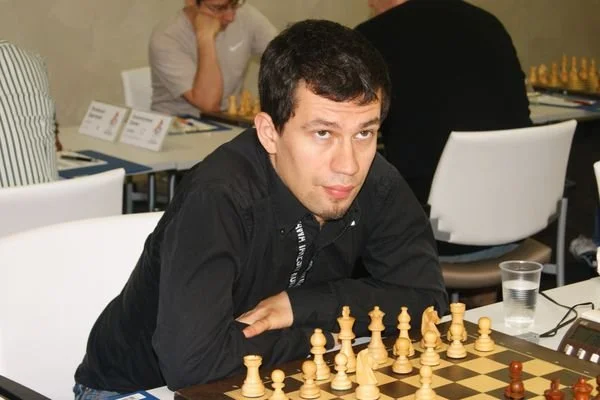
Alekseev wins the Viktor Korchnoi Memorial, 2017. Photo via Ruchess
Introduction
Evgeny Vladimirovich Alekseev, born on 28 November 1985 in Pushkin near St Petersburg, belongs to a generation that stood at the hinge between late Soviet chess culture and the hard, internationalized professional circuit that emerged after the Soviet collapse. FIDE records him as a grandmaster from 2002, with International Master title in 2000, and as of 2023 a player representing Israel rather than Russia. His competitive high point came in the second half of the 2000s, when he won the Russian Championship, captured the Aeroflot Open, shared second at Dortmund, won Biel, and rose to a peak FIDE rating of 2725, with a peak world rank of fifteenth.
Alekseev is not one of the headline-defining world championship figures of his era, yet that is precisely why he repays closer attention. He was strong enough to enter the world top fifteen, dangerous enough to make deep runs in elite events, and durable enough to remain visible long after his peak years. His career also illuminates how the St Petersburg school, with its inherited Soviet training culture, continued to produce world-class professionals in the post-Soviet decades.
Early Life and Chess Formation
The accessible biographical record on Alekseev is more informative about his chess upbringing than about his family life. Russian and regional sources agree that he was born in Pushkin, the former Tsarskoe Selo, and an interview from the 2007 Russian Championship states that his father taught him chess when he was seven. The game caught him immediately, and he was soon sent to study at the Palace of Pioneers, a classic Soviet and post-Soviet institutional pathway for talented children.
By the end of the 1990s he had become one of the leading young players in Russia. The Russian Chess Federation’s biographical sketch says he won the national children’s championship twice, helped Russia win the World Youth Olympiad, and also won a world youth title. That same official sketch places him squarely in the St Petersburg chess milieu, where strong local competition and a dense trainer network gave ambitious juniors unusually rich conditions for growth.
His formal education did not disappear entirely behind chess. In 2005 the North-West Academy of Public Administration listed him on its honor board as a fourth-year student in the Faculty of State and Municipal Administration. That detail is useful because it shows Alekseev as something other than a narrowly specialized prodigy. At the 2008 FIDE Grand Prix in Elista, when asked whether chess professionals need higher education, he answered in a reflective, distinctly unromantic way: modern people, he said, need education, but for chess professionals a university diploma is not strictly necessary. This does not tell us exactly how he balanced university and chess over time, but it does show that he thought consciously about the question.
Just as important was the list of trainers and helpers around him. The Russian Chess Federation names Sergey Sivoho, Konstantin Sakaev, Igor Khenkin, Konstantin Landa, Alexey Korotylev, and Sergey Dolmatov among those with whom Alekseev worked; it also notes that Boris Grachev served as his second for many years. This is a revealing catalogue. Alekseev did not arise from a single guru-centered narrative, but from a broad professional environment, one in which opening work, match preparation, technical training, and practical tournament advice circulated through a network of masters and grandmasters. That networked formation is itself a hallmark of Russian elite chess after 1991.
Rise in Competitive Chess
Alekseev’s transition from gifted junior to serious adult competitor was unusually rapid. The Russian Chess Federation states that in 2001 he won the men’s championship of St Petersburg and also helped a Neva-based team win the Russian team championship. In the same early period he won in Tel Aviv, and in 2002 victories at the Hoogovens open and the Alexander Petrov Memorial were followed by the award of the grandmaster title. The North-West Academy’s own pages, meanwhile, treated him not as a casual student player but as one of the institution’s public distinctions.
By 2004 he was already participating in the FIDE knockout world championship cycle, and over the next decade he became a regular World Cup presence. This regularity is significant. Alekseev was not simply a strong open-tournament grandmaster. He was, for a substantial stretch, a recognized member of the Russian elite pool, the kind of player who could qualify repeatedly for the hardest international events and was expected to be competitive there.
The decisive breakthrough came in the 2006 Russian Championship Superfinal. ChessBase’s report records that Alekseev and Dmitry Jakovenko tied for first on 7.5 out of 11, after which Alekseev won the rapid playoff by 1.5 to 0.5. That result changed his standing immediately. Winning a Russian Superfinal in that period meant surviving one of the deepest national championship fields in the world, against a concentration of players who were often world-class by any international standard. Alekseev was suddenly not just promising, but proven.
He followed that title in 2007 with the strongest sequence of his career. ChessBase reported that he won the Aeroflot Open outright, qualifying for Dortmund. The Russian Chess Federation’s later biographical sketch adds that in Dortmund he shared second place, and in the 2007 World Cup he eliminated Evgeny Bareev, Laurent Fressinet, and Konstantin Sakaev before losing to Sergey Karjakin in the quarterfinals. Russia also won the European Team Championship that year, and the final standings show Alekseev as part of the victorious Russian squad. These were not isolated successes. Taken together, they show a player who, for roughly two years, was capable of moving between open events, elite round robins, knockout pressure, and team competition without losing effectiveness.
Major Career Achievements
If the 2006 Russian title announced Alekseev nationally, Biel 2008 confirmed him as a genuine super-grandmaster class competitor. ChessBase’s reports from Biel show him first climbing back into contention, then catching Leinier Dominguez in the last round and winning the tiebreak. A separate report from the same event notes that Magnus Carlsen, pressing too far in a game against Alekseev, lost the race in a pawn ending. The Russian Chess Federation’s later biography went further, pointing out that Alekseev beat Carlsen in their individual Biel encounter and that their ten tournament games overall ended with Alekseev leading 5.5 to 4.5. One should not exaggerate this into some larger verdict on either player’s place in history, but it does explain why Alekseev was taken seriously by his contemporaries at his peak.
His rating history confirms the same point. 2700chess gives Alekseev a peak FIDE rating of 2725 in September 2009 and a peak world rank of fifteenth in October 2007. ChessBase’s discussion of the October 2007 list noted his sharp jump upward into the top tier of world rankings. Those numbers are helpful because they protect his reputation from both nostalgia and neglect. Alekseev was not merely a strong domestic master who happened to win a Russian title once. For a time he was objectively among the world’s leading players.
His career after Biel remained serious, even if less incandescent. The official World Cup 2009 page shows him reaching the quarterfinal stage, where he faced Fabiano Caruana. The Russian Chess Federation also records his participation in the 2008-2009 FIDE Grand Prix series. In Russia he remained stubbornly relevant: the federation’s biographical note records that in the 2008 Superfinal he shared first through third before ending third after playoffs, and in the 2012 Superfinal he tied for first through sixth before losing out in the rapid playoff. In 2013 Mark Crowther’s report on the European Individual Championship records that Alekseev finished in the large group tied for first on 8 out of 11 and took silver on tiebreak behind Alexander Moiseenko. That result, though not a title, is one of the best single proofs of his enduring class.
Team chess was another substantial part of his profile. The Russian Chess Federation says he became a two-time European Club Cup winner with Economist Saratov, and Mark Crowther’s report on the 2009 European Club Cup lists Economist-SGSEU Saratov as the winning team, with Alekseev among its leading players. This strand of his career is easy to underrate because club competitions are often treated as secondary in historical writing. In practice, success there signaled trustworthiness at a very high level. Clubs stocked with powerful grandmasters did not hand key boards to passengers. Alekseev’s repeated presence in those lineups indicates that captains and sponsors saw him as a dependable performer.
His later years also contained meaningful local and symbolic successes. Reference and federation sources record that he became St Petersburg champion in 2017, and the Russian Chess Federation reported that the same year he won the Viktor Korchnoi Memorial on tiebreak ahead of Dmitry Kokarev, Aleksandr Shimanov, and Gata Kamsky. These were not world defining victories, but they show that Alekseev did not simply fade after his world top-fifteen phase. He remained a formidable player within the historically rich St Petersburg scene that had formed him.
Style and Reputation
Alekseev’s own comments are the best starting point for understanding his chess. In his long interview after winning the 2006 Russian Championship, he said plainly, “I consider myself a counterattacking player,” and added that playing “first number” was harder for him. In the same interview he explained that much depended on opponents trying to beat him, because then he could strike in reply. This is unusually direct self-diagnosis, and it fits both the tournament record and the impression he left on peers.
Just as revealing is the way he described his aesthetic. In the same interview, and again in the Russian Chess Federation’s later biographical sketch, Alekseev said that he never liked to “force the position,” compared himself loosely to Peter Leko while trying to be more active, and even suggested that his play was in some ways closer to Capablanca. ChessBase, reporting on Aeroflot 2007, echoed this by describing his ideal as Capablanca and characterizing his chess as simple, sound positional play with tactical touches rather than theatrical excess. None of this should be read as a claim that Alekseev played like those champions in any absolute sense. It does, however, show how he wanted his own chess understood: principled, economical, and practical.
The strengths and weaknesses of that style were closely connected. Alekseev was excellent in situations where an opponent overextended or where an apparently modest position still contained latent dynamic resources. His success in rapid playoffs, his deep World Cup runs, and his repeated ability to rescue or even win tense practical struggles all support that reading. At the same time, his own admission that he was less comfortable “first number” helps explain why he did not become a permanent contender in the absolute top circle. Players who dominate there usually impose on equal positions more relentlessly than Alekseev ever claimed to do.
He also comes across in the record as notably self-critical. The Russian Chess Federation quotes him saying that even after wins he remained skeptical of his own play and recognized that sometimes he had simply played less badly than the opponent. This is not a trivial character note. It suggests a professional mentality shaped less by mythmaking than by technical honesty, and that seriousness likely helped him survive the brutal depth of the Russian competitive environment for so long.
Contributions Beyond Tournament Play
Alekseev’s public legacy outside pure competition lies less in books or celebrity commentary than in steady service to the chess community. The accessible source record does not point to a major parallel career as a prolific author or permanent high-profile second under his own name. What it does show, repeatedly, is a grandmaster who remained present in exhibitions, youth events, and public chess programs. In 2017 the Russian Chess Federation reported that he gave a simultaneous exhibition to police employees and veterans in St Petersburg. In 2023, during the Russian Superfinal social program, he spoke with participants about his background and wished young players success in their improvement. In 2024 he appeared as an honorary guest at a St Petersburg Karpov Cup festival. These activities do not make him an institution-builder on the scale of a Botvinnik or Dvoretsky, but they do show a continuing civic role within Russian chess culture.
His most important working relationships remained those of trainer, second, club, and federation. The long list of coaches around him, plus Boris Grachev’s years as his second, indicates that Alekseev functioned inside a collaborative professional ecology rather than as an isolated genius. His service to teams from St Petersburg and to Economist Saratov refined that profile further. Club chess, national team duties, and repeated qualification events placed him in the thick of professional collective chess, where preparation, reliability, and adaptability often count as much as individual brilliance.
One lesser-known but relevant thread concerns Israel. A historical survey of chess in the Maccabiah records that in 2001 Alekseev shared first in the main Maccabiah competition. More than two decades later, FIDE records his federation transfer from Russia to Israel on 10 March 2023. It would be careless to claim a direct causal line between those facts, because the sources reviewed here do not establish one. Still, the pair of details is historically suggestive. Alekseev’s eventual Israeli representation was not his first documented association with Israeli chess space.
Historical Legacy
Historically, Alekseev deserves to be placed among the strongest Russian grandmasters of the generation between the older Kramnik-Svidler-Morozevich cohort and the later wave associated with Karjakin, Nepomniachtchi, and others. He did not become a world title challenger, and that absence has probably contributed to how rarely he appears in general histories. Yet this omission can distort the actual texture of top-level chess in the 2000s. A player who wins the Russian Superfinal, reaches the world top fifteen, takes Aeroflot and Biel, shares second at Dortmund, and repeatedly survives deep national and international qualification structures is not a marginal figure. He is evidence of just how deep that era really was.
He also has value as a case study in institutional continuity. Alekseev was born in the Soviet Union but formed competitively in the 1990s and 2000s, through family initiation, Palace of Pioneers training, St Petersburg coaching networks, and the Russian championship system. In other words, he was not a Soviet champion in the classic sense. He was a post-Soviet elite player built out of surviving Soviet structures. That makes him especially relevant for a site interested in long-range continuities in Russian and Soviet chess culture.
Why does Evgeny Alekseev deserve attention today? Because his career shows what serious historical chess writing often needs but popular memory often neglects: the tier just below the world-title narrative, where national championships, club competitions, rating peaks, team duties, and repeated qualification battles reveal the true depth of an era. Alekseev was not merely a supporting actor around greater stars. At his best he was one of the world’s fifteen strongest players, a Russian champion, a major tournament winner, and a distinctly St Petersburg representative of positional, counterattacking professionalism. That is more than enough to justify sustained historical attention.
Notes and Sources
This profile is based primarily on FIDE records, Russian Chess Federation biographical and event material, contemporary tournament reporting, and a small number of institutional and specialist reference sources. The load-bearing primary or near-primary materials are Alekseev’s FIDE profile, the Russian Chess Federation’s “Person of the Day” entry and tournament reports, his 2006 interview after winning the Russian Championship, the North-West Academy of Public Administration honor-board notice, official or quasi-official event result pages for the World Cup and European Team Championship, and contemporary reports from ChessBase and Mark Crowther’s The Week in Chess. For ratings context and peak placement, 2700chess is used as a reference index. Russian sources generally use the form Евгений Алексеев, while English-language reporting alternates between Alekseev and Alexeev.
A final, concise assessment follows from that source base. Alekseev should be remembered not as an accidental Russian champion or a forgotten near-elite, but as a genuine top-tier professional of the post-Soviet St Petersburg school whose peak years captured the density, discipline, and competitive seriousness of Russian chess after the Soviet era.
