Kiril Georgiev
Introduction
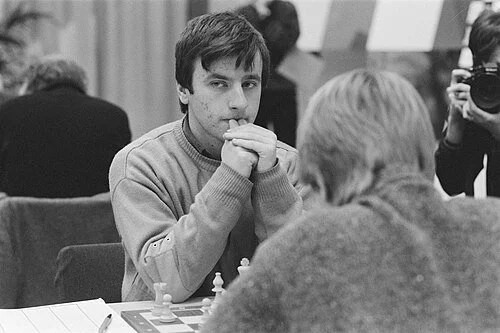
Kiril Dimitrov Georgiev, born on November 28, 1965 in Petrich, belongs among the most important Bulgarian grandmasters of the late twentieth and early twenty first centuries. His career has unusual breadth. He was World Junior Champion in 1983, became a grandmaster in 1985, entered the world top ten in 1993, reached a peak Elo of 2695 in July 2001, won major open and invitational events across Europe, collected seven Bulgarian national titles by 2023, and remained competitively relevant well into senior chess. If he is sometimes omitted from simplified narratives of postwar Eastern European chess, that omission usually says more about those narratives than about Georgiev’s actual standing. He was one of the central carriers of Bulgarian master strength between the generations of Ivan Radulov and Veselin Topalov, and one of the clearest examples of a player who sustained elite relevance across very different chess economies and institutions.
Georgiev also deserves attention because his career illuminates a specific historical passage. He grew up in a Bulgarian chess culture that still relied heavily on Russian-language literature, structured training, and state-supported competition, then adapted to the internationalized open-tournament world that followed the end of the socialist period. His own recollections are unusually useful here. He remembered studying Russian chess books at the age of nine with help from his father, and later contrasted the material support once available to strong players with the more precarious realities of the modern tournament profession. His life in chess is therefore not only the life of a strong player. It is also a case study in continuity, adaptation, and professional endurance.
Early Life and Chess Formation
Georgiev was born in Petrich, in southwestern Bulgaria, and learned the game in a family setting where chess was already taken seriously. His father, Dimitar Georgiev, was a teacher, a Russian speaker, and a strong amateur player who reached candidate master strength according to Bulgarian reporting. Georgiev later said that he first handled the pieces at about seven years old while watching games played by his father and uncle, and that by age nine he was already reading Russian chess books systematically. That combination of household instruction and Russian-language access clearly shaped his early formation. It gave him a base in the Soviet and East European instructional tradition before the computer era and helps explain why contemporaries in Bulgaria later called him “a living encyclopedia.”
His schooling and early chess migration also fit the pattern of a talented provincial player moving into stronger competitive environments. After his early years in Petrich, Bulgarian reporting states that he studied at the Technical School of Public Catering in Plovdiv and later attended Sofia University, where he studied economics. Georgiev himself recalled that by age fourteen he had decided to devote himself primarily to chess, and that at fifteen he moved to Pernik so he could train and compete more intensively. Russian Chess Federation biographical material notes that he reached the men’s final of the Bulgarian championship at fifteen, which suggests that his rise was already visible before his international breakthrough.
What formed him most deeply was not only talent, but method. Georgiev’s own testimony describes a disciplined, book-centered culture of preparation in which finding and ordering games on a given line could take days or weeks. That world rewarded memory, structured study, and broad opening literacy. It also helps explain why his later chess would be described not as narrowly tactical or narrowly positional, but as technically well-rounded and informed by a large stock of accumulated knowledge.
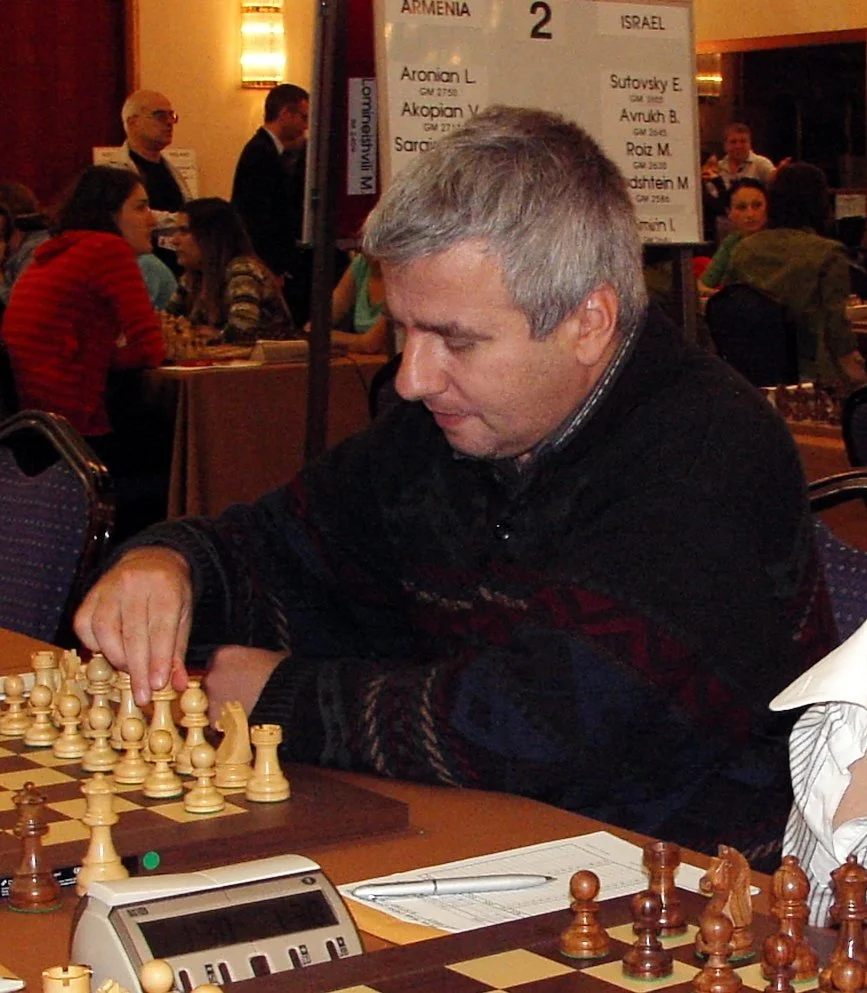
EuroChess Iraklion 2007. By karpidis from Piraeus, Greece - alteration of KIF_5248, CC BY 2.0
Rise in Competitive Chess
Georgiev’s decisive international breakthrough came in 1983, when he won the World Junior Championship in Belfort with 11.5 points out of 13. OlimpBase’s world junior record confirms the title, while Georgiev later recalled not only the score but also the strength of the field, which included Nigel Short, Evgeny Bareev, Valery Salov, Maxim Dlugy, and Gilberto Milos. Bulgarian and Russian retrospective sources treat the result as a turning point for both the player and Bulgarian chess more broadly. In practical terms it established Georgiev as more than a local prodigy. It marked him out as a player capable of beating the strongest cohort of his age internationally.
The World Junior title was not an isolated success. In the same period Georgiev was already appearing in senior team competition. At the 1983 European Team Championship in Plovdiv he scored 4 out of 6 on reserve for Bulgaria, a strong showing for a teenager in adult company. Russian Chess Federation material notes that he soon surpassed the long established Bulgarian leader Ivan Radulov and became the country’s first board for much of the period from 1984 to 1992, until Veselin Topalov’s ascent changed the internal hierarchy. His grandmaster title followed in 1985, and by the middle of the decade he had clearly ceased to be merely promising. He had become the leading representative of Bulgarian men’s chess in major team events.
This early rise also had a distinct cultural texture. Georgiev came of age in late socialist Bulgaria, where serious players still depended on printed analysis, federation structures, team championships, and state backed travel. He later remembered that in earlier decades players could count on salaries, grants, training camps, and travel support. That description should not be romanticized, yet it is directly relevant to understanding how his generation was formed and why Georgiev could become such a deeply prepared professional before the wider opening of the international chess market.
Major Career Achievements
Georgiev’s mature career did not follow a single upward line toward a Candidates match or world title challenge, but it accumulated a substantial set of achievements that place him securely in the historical first rank of Bulgarian grandmasters below the world champion tier. He shared the Bulgarian championship in 1984 and won it outright again in 1986 and 1989. He played 15 Chess Olympiads between 1984 and 2012, mostly for Bulgaria and once for Macedonia in 2002, scoring 100 points in 167 games overall. Several of those performances were especially strong, including 9.5 out of 14 on board one in 1986 and 8.5 out of 13 on board one in 1992. Those numbers are not incidental. They show sustained responsibility at the highest team level over nearly three decades.
One essential episode in his reputation came at the first official World Blitz Championship in St. John’s in 1988. FIDE’s historical account records that the tournament field included Kasparov, Karpov, Tal, Vaganian, Seirawan, Salov and others, and that Georgiev eliminated Garry Kasparov in the quarterfinal before losing a dramatic semifinal to Rafael Vaganian. Later FIDE coverage and Georgiev’s own recollections both continued to identify the Kasparov match as one of the defining moments of his career. It was not a classical result, and it did not alter the world championship structure, but it permanently fixed Georgiev in chess memory as a formidable blitz player capable of overthrowing the strongest opposition under pressure.
In the classical world championship cycle he came close enough to show real class without quite breaking through to the final inner ring. Russian Chess Federation material notes his participation in the 1990 Interzonal, and tournament databases place him on 7.5 out of 13 at Manila, just outside the qualifying places for the Candidates stage. A contemporary newspaper report from 1993 described Judit Polgar as tying for second behind Georgiev in the Budapest zonal, which confirms the significance of his zonal success that year. By Georgiev’s own recollection, and by later Russian and Bulgarian summaries, 1993 was the year he entered the world top ten. That is the right way to read this phase. He was not merely a dangerous outsider. For a period, he was objectively one of the ten strongest players in the world by rating position.
His strongest later tournament phase came around the turn of the millennium and into the middle 2000s. The Week in Chess recorded his clear first place in Sarajevo’s Bosnia 2001 event, and 2700chess gives his career peak rating as 2695 in July 2001. He shared first at Gibraltar in 2005 and then won Gibraltar outright in 2006 with 8.5 out of 10, one full point ahead of Nigel Short and Emil Sutovsky according to TWIC. In the same year he took bronze at the European Individual Championship, with chess-results confirming third place behind Zdenko Kožul and Vassily Ivanchuk. This cluster of results captures Georgiev at full maturity: not a single spectacular spike, but a sequence of victories and high finishes in very strong fields that confirmed his enduring status as an elite professional.
His longevity was also exceptional. Georgiev won the Bulgarian championship again in 2013, 2014, and 2015, with contemporary reports describing the 2015 title as his sixth national crown. ChessBase coverage of the 2023 Bulgarian Championship then recorded his seventh title, achieved ahead of the young star Nurgyul Salimova. In 2021 FIDE highlighted his World Cup upset of Parham Maghsoodloo, then rated more than one hundred points higher, and in 2024 FIDE listed him as the top seed in the World Senior Championship 50+ section. These results do not simply show that he kept playing. They show that he kept winning important games against serious opposition across generations.
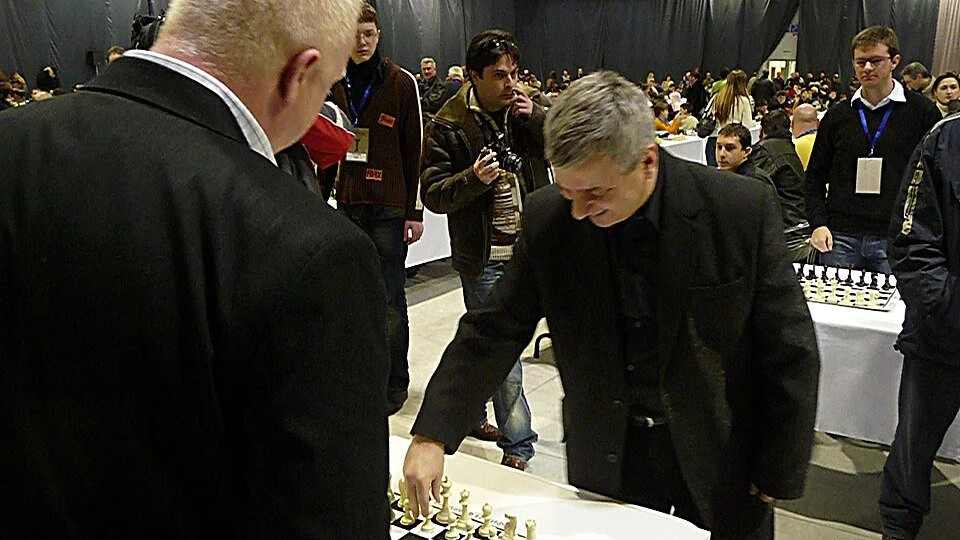
Georgiev giving a simul. Kidon, CC BY 3.0
Style and Reputation
Georgiev described his own style in 2014 as “universal,” adding that he aimed to play well in the opening, middlegame, and endgame. That self-description aligns closely with the way other strong commentators wrote about him. In 2007 ChessBase referred to him in passing as “one of the most technical players himself,” and the same interview material from 2014 emphasized his endgame technique. These are not empty compliments. They point to the defining quality of Georgiev’s chess. He was rarely a one-dimensional specialist. He combined deep opening experience with practical middlegame judgment and strong conversion skills, especially in technical endings.
A second persistent feature of his reputation was his fighting disposition. In his Chessdom interview he said flatly that he always played for a win, and even in open tournaments often scored heavily with Black. That claim is consistent with the range of his best known achievements, from the 1988 blitz upset of Kasparov to his repeated success in strong open events such as Gibraltar and Karpos. Even when Georgiev chose solid systems, he used them as instruments of control rather than passivity. His own opening work, which includes books on the Najdorf Sicilian, anti-gambit systems, anti-London structures, the English Opening, and later repertoire material against 1...d5, reinforces the image of a player who valued practical initiative and well-prepared positions rather than stylistic dogma.
The “living encyclopedia” tag attached to him in Bulgaria during the 1980s is also historically revealing. It reflected not just memory, but a particular kind of authority grounded in book study and analytical range. Georgiev belonged to a generation for whom mastery depended on internalized literature and over the board experience rather than engine dependence. Later in life he criticized the way computer preparation could “dry out” openings, which suggests that his ideal of chess remained tied to human understanding, flexibility, and the practical art of finding workable ideas at the board.
Contributions Beyond Tournament Play
Georgiev’s contribution to chess extends well beyond his tournament crosstables. He became a substantial opening writer and trainer. Publisher materials and bibliographic records credit him with, among other works, The Sharpest Sicilian with Atanas Kolev, Squeezing the Gambits, Fighting the London System, The Modern English with Semko Semkov, and Attacking 1...d5. The range of those books is significant. It shows a player engaging with both sides of the board, with sharp and quiet structures, and with repertoire construction rather than isolated novelty hunting. More recently, Modern Chess has hosted instructional courses by Georgiev on openings and endgames, further extending his teaching profile. FIDE’s directory also lists him as a FIDE Trainer.
He also moved into organizational and institutional work. Chess Stars and New In Chess publisher biographies state that he coached the Bulgarian national team, while Georgiev himself said in 2017 that he had recently taken up coaching more seriously, co-opened the Blitz chess club in central Sofia, supported the revival of chess in his hometown of Petrich, and envisioned a “Kiril Georgiev” chess school. In the same interview he explained that in April 2016 he helped found the Bulgarian Chess Union 1931 in opposition to the disgraced federation structures then under criticism. Whatever one thinks of the complicated politics of Bulgarian chess, Georgiev’s public role during that crisis shows that he was not merely a famous player standing at a distance from institutions. He was willing to intervene in how chess in his country was governed.
Important relationships also run through this later phase. His wife, Emilia Encheva Georgieva, was publicly described in Bulgarian reporting as a sports graduate, chess trainer, and long-time managerial partner in his career, and Georgiev himself credited family support as “the cornerstone and the motor” of his activities. His writing collaborations with Atanas Kolev and Semko Semkov likewise place him within a specifically Bulgarian network of post-1990 chess publishing. These ties help explain the continuity of his work across playing, teaching, and organizing.
Historical Legacy
Georgiev’s historical place is best understood through durability, transition, and standard of play. He was the leading Bulgarian male player for a substantial stretch after Radulov and before Topalov’s full emergence, then remained a national force long after Topalov’s generation had become established. Russian Chess Federation summaries place him on Bulgaria’s first board through much of the 1980s and early 1990s, while OlimpBase records 15 Olympiad appearances. That long service places him among the most consequential national team players in Bulgarian history.
His wider international legacy is subtler than that of a world title challenger, yet in some ways more representative of how elite chess actually functions. Georgiev never needed the aura of a single world championship match to secure historical standing. His legacy rests on a long body of serious work: a junior world title, repeated national championships, entry into the world top ten, victories in strong international events, a renowned blitz scalp of Kasparov, high-level authorship, and visible service to clubs, students, and institutions. The fact that he remained dangerous in events such as the 2021 World Cup and the 2023 Bulgarian Championship strengthens that legacy by showing continuity rather than nostalgia.
A fair historical assessment, then, is that Kiril Georgiev deserves attention today because he embodies a class of grandmaster often undervalued in simplified chess history: the player who was not merely present in many eras, but competitively significant in all of them. He linked late socialist Bulgarian chess culture to the post-Soviet and globalized tournament world. He combined encyclopedic preparation with practical fighting skill. He wrote, coached, organized, and kept performing. For a website devoted to serious chess history, he is not a peripheral figure. He is one of the most revealing Bulgarian players of his generation.
Notes and Sources
This profile relies first on primary or near-primary sources: Georgiev’s own long interviews with Vera Jürgens for ChessBase and with Iva Videnova for Chessdom, his current FIDE profile and transfer record, FIDE event coverage, and team and championship records preserved by OlimpBase. For tournament placement and standings, I used FIDE, OlimpBase, TWIC, and chess-results where appropriate. For Bulgarian biographical detail, especially family background and education, I used a substantial 2017 interview in Struma, treating its claims carefully and preferring external confirmation when possible. Russian-language retrospective context came from the Russian Chess Federation’s “Person of the Day” profile.
Where the evidence supports only a careful inference, I have presented it as interpretation rather than hard fact. That applies especially to Georgiev’s broader historical place within Bulgarian chess culture. The central factual points of the article, including birth data, titles, Olympiad participation, major tournament results, published works, training role, and later public activity in Bulgarian chess, are grounded in the cited sources above.
