Introduction
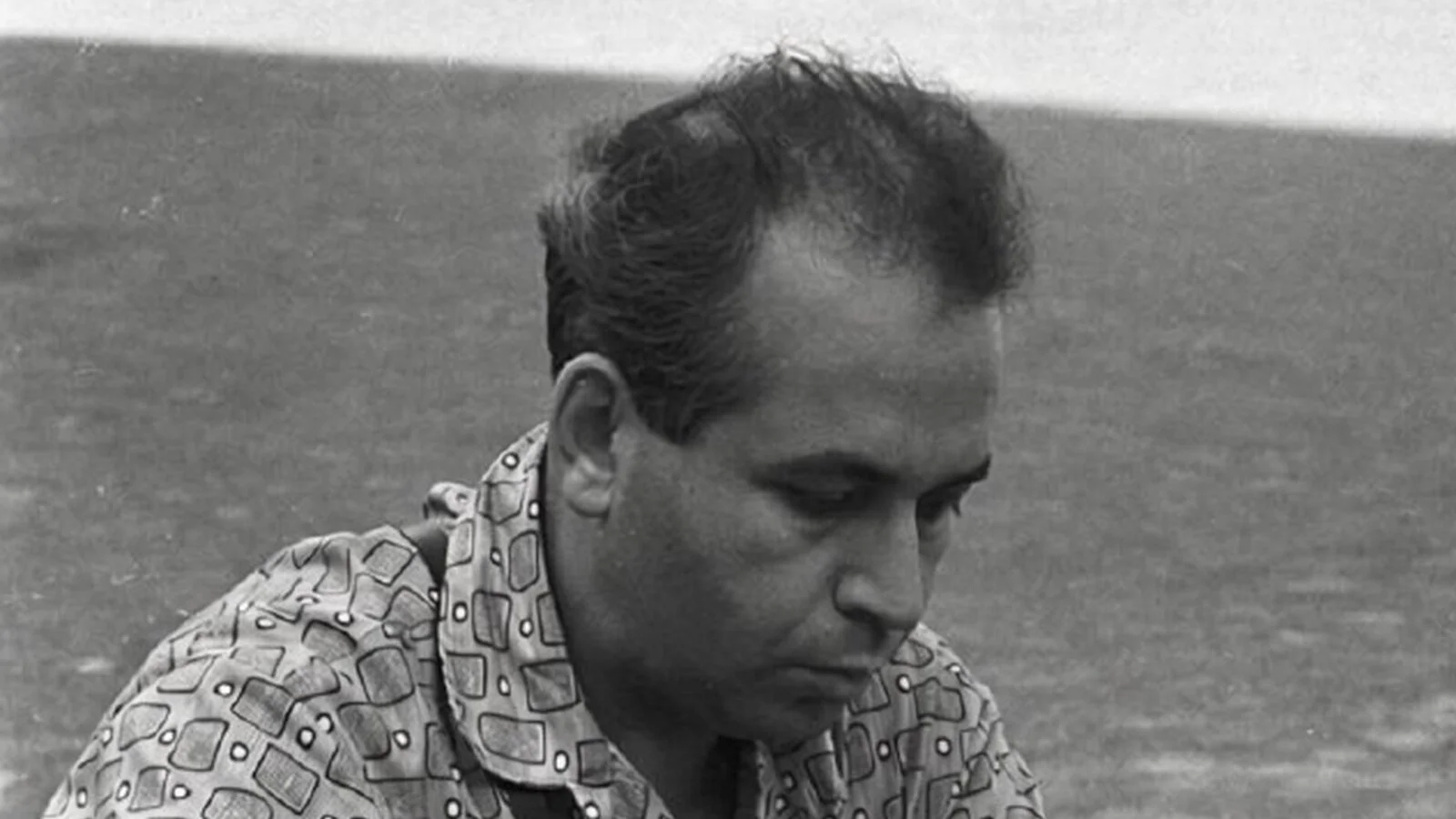
Yakov Vladimirovich Damski (1934–2009) was a Soviet chess master, journalist, author, and international arbiter. A two-time champion of Kazan and champion of the Tatar ASSR, he became widely known through his radio and television reports and his books about leading players. English-language editions often identify him as Iakov Damsky. [1, 2, 11]
His career connected the chess community of Kazan with the tournament halls, broadcasting studios, and publishing houses of Moscow. His collaborations with Mikhail Tal and Vladimir Kramnik preserved the champions’ explanations of their work, while his biography of Rashid Nezhmetdinov recorded the achievements of his own teacher. [4, 9, 11]
Early Life and Chess Formation
Damski was born on 24 April 1934 in Vitebsk. The German invasion of the Soviet Union uprooted his family in 1941, when he was seven. They eventually settled in Kazan, where he grew up and received his education. [2]
In a 2006 interview with Mark Livshits, Damski recalled leaving Vitebsk with his mother and grandmother shortly before the city fell. Their journey was interrupted by bombing near Smolensk. After reaching Moscow, they continued east and left the train at Kazan. His father, a serviceman who had remained behind, subsequently found them there. These details come from Damski’s recollections many decades afterward. [3]
He learned chess during his school years. The Russian Chess Federation places his introduction to the game in the sixth grade. Kazan provided the setting for his development, and Nezhmetdinov became an enduring influence. In the preface to his teacher’s biography, Damski recalled repeatedly entering Nezhmetdinov’s name in the space marked “Your coach” on official forms. [1, 4]
Rise in Competitive Chess
Damski won the Kazan championship in 1954 and again in 1958. In 1961 he became champion of the Tatar ASSR. He also competed in Russian republic championship semifinals and in the championship of the Nauka sports society’s Central Council. These results established his standing within regional Soviet chess. [1, 2]
According to a retrospective published by the Russian Chess Federation, he achieved the candidate-master norm in the 1955 Russian republic team championship. His opportunity to meet the master norm came at the Kazan chess club’s 1963 tournament, organized by Nezhmetdinov. Damski shared first through third place and fulfilled the requirement. The account emphasizes the difficulty of finding suitable qualifying events locally. [5]
His later reporting therefore drew on substantial competitive experience. He understood the demands of preparation, calculation, and tournament play from his own years at the board. His Soviet Master of Sport qualification remained part of his professional identity throughout his writing and broadcasting career. [6]
From Newspapers to Broadcasting
Damski graduated from Kazan State University in 1956. In his account to Livshits, he described initially entering a scientific course before transferring to philology. A journalism specialization subsequently became available, bringing his literary interests into a professional course of study. [3, 6]
His early employment included the factory newspaper Mekhovshchik, followed by years at Komsomolets Tatarii as a correspondent and department head. He moved to Moscow in 1965 and worked for Moskovsky Komsomolets. From 1967 he served as a sports commentator for Central Television and All-Union Radio. [2, 6, 7]
Among his television assignments was Club of the Four Knights, a chess program associated with David Bronstein. Radio became another enduring outlet, particularly through Mayak. Damski’s work placed chess within the daily experience of listeners who followed major competitions through a familiar voice. [5, 6]
Journalist Yuri Vasiliev remembered how quickly Damski could move from a discussion among colleagues into a broadcast. He would ask for quiet, then deliver a vivid report without notes. Vasiliev recalled that the other journalists stopped their analysis to listen. [7]
A contemporary obituary in Championat described his ability to explain complicated play within the few minutes available on air. The tribute emphasized the accessibility of his commentary to viewers and listeners with modest playing strength. [8]
Working with Mikhail Tal
Damski’s collaboration with Tal grew out of a close friendship. He recalled Tal staying for extended periods at his Moscow home and his own visits to Riga. Their shared life included conversation, singing, and blitz chess, as well as the sustained work of producing books. [5]
Their 1978 volume V ogon ataki, literally “Into the Fire of Attack,” used a dialogue between the player and the journalist to explore Tal’s development and chess ideas. Its opening makes the collaboration visible: the authors discuss their disagreements, joint analysis, and the interruptions caused by Tal’s tournament schedule. Damski’s questions give the narrative its direction and invite Tal to explain experiences that readers could not recover from game scores alone. [9]
The book combined this conversation with annotated games and reflections on chess. Its publication details record a print run of 100,000 copies. That figure documents the scale on which their collaboration entered Soviet chess literature. [9]
The partnership also produced Attack with Mikhail Tal, published in English in 1994. Its instructional focus was the conduct of attacks across different kinds of positions. The publisher identifies it as Tal’s final book, written with Damski. [10]
Biography and the Craft of Chess Writing
Damski’s Rashid Nezhmetdinov appeared in 1987. His preface openly acknowledged his affection for its subject and the personal character of the undertaking. He also explained the research behind it, thanking people who helped locate unpublished or difficult-to-find material. [4]
His treatment of annotations reveals a considered editorial method. Damski retained his teacher’s comments where they conveyed the player’s intentions, emotions, and understanding of a decisive moment. He revised assessments and variations that subsequent scrutiny had weakened. The result joined the historical voice of the player to later analytical judgment. [4]
Damski also wrote about defensive play. The Art of Defence in Chess, coauthored with Lev Polugaevsky, reached English-language readers; a 1996 Cadogan edition credits both men. Such collaborations allowed Damski to work closely with players whose approaches to chess differed considerably. [12]
These books show a recurring concern with how players reached decisions. The biographical setting, the questions posed by an interviewer, and the organization of the commentary helped readers follow the thinking behind a game. [4, 9, 11]
Kramnik and the Next Generation
Kramnik: My Life and Games, published in English in 2000, offers unusually clear evidence of Damski’s contribution to a jointly authored book. The authors’ foreword assigns him the biographical chapters and the introductions to selected games, except where another author is identified. Kramnik supplied the annotations to the selected games and analyzed some additional encounters. [11]
That division of work joined a developing player’s recollections and analysis to Damski’s experience in shaping a narrative. It also extended his collaboration with world-class players into a younger generation. [11]
In the same year, Damski and Sergei Shipov published Poslednyaya intriga veka: Kasparov–Kramnik, London 2000, an account of the world championship match. Shipov later credited Damski with substantial help in his development as a writer, columnist, and commentator, including support through his publishing contacts. [7, 13]
Arbitration and Personal Relationships
Damski also held the international arbiter title and officiated at major events in Russia and abroad. The Russian National Public Library for Science and Technology’s commemorative account records that he headed the Russian Chess Federation’s panel of arbiters. Tournament administration formed a further part of a career already encompassing competition, journalism, and publishing. [6, 14]
Kramnik’s recollections give a personal measure of their relationship. After Damski’s death, he described him as a second father and remembered gatherings at the family’s dacha. He emphasized Damski’s humor, hospitality, and interest in people regardless of their position in the chess world. [7]
Later Life
Damski continued writing and editing in the post-Soviet period. His books included Vek shakhmat (A Century of Chess), published in 2000; Po zakonam krasoty (By the Laws of Beauty), published in 2002; and Korol Boris Desyaty (King Boris the Tenth), his 2004 book about Boris Spassky. [15]
The Spassky volume drew on the champion’s published annotations, Damski’s memories, and the testimony of people who knew its subject. By the Laws of Beauty examined aesthetic judgment in chess through a substantial collection of annotated games. Together, these works continued his interest in the relationship between a player’s personality, the experience of competition, and the ideas expressed on the board. [15]
He also worked on chess publishing at RIPOL Klassik. In 2006 he told Livshits that he edited other authors’ books as well as his own. The library’s later commemoration identifies him as one of the leading figures in the publisher’s chess series. [3, 14]
Damski died in Moscow on 29 July 2009, aged seventy-five. His obituaries recalled a working journalist whose voice had accompanied chess coverage for decades and whose books had reached readers in several languages. [1, 8]
Legacy and Historical Assessment
Damski’s contribution to chess culture rested on the combination of a master’s practical knowledge and a journalist’s ability to draw out an explanation. His books preserve extended conversations, biographical evidence, and accounts of how strong players understood their own games.
The Nezhmetdinov preface, the dialogue with Tal, and the explicit division of authorship in Kramnik’s book provide concrete evidence of that work. They show how Damski helped turn personal experience and specialized knowledge into a readable record. His career belongs within the history of Soviet chess both as a competitor and as one of the people who documented and explained it. [4, 9, 11]
Notes and Sources
Russian Chess Federation, “Яков Дамский.” Biographical entry. Used for his school-age introduction to chess, regional championships, competitive activity, and international readership. ruchess.ru
Tatar-inform, “Умер казанский патриарх шахматной журналистики,” 30 July 2009. Contemporary obituary documenting his birth, evacuation, newspaper work, and Kazan titles in 1954 and 1958. tatar-inform.ru
Mark Livshits, “У микрофона Яков Дамский!” Interview published in Vesti, summer 2006; republished by e3e5.com, 30 July 2009. First-person evidence for evacuation, university studies, and editing. Its recollections of ages and early chess dates differ from institutional biographies; the precise championship dates here follow notes 1 and 2. e3e5.com
Я. В. Дамский, Рашид Нежметдинов (Moscow: Fizkultura i sport, 1987), 3–4. Author’s preface, consulted in digitized text. Publication details also confirmed by the Russian State Library catalogue. 1987
Russian Chess Federation, “По законам красоты,” 28 April 2009. Retrospective incorporating Damski’s recollections. Used for the 1963 master norm, broadcasting, and friendship with Tal. The norm date is distinguished from the formal award date, which later references do not report consistently. ruchess.ru
All-Russian Research Institute of Physical Culture and Sport, Encyclopedia of Sport, “Дамский Яков Владимирович. СССР, журналист.” Institutional entry confirming graduation in 1956, the Moscow move, broadcasting from 1967, and professional titles. es.vniifk.ru
Sovetsky Sport, “С вами был Яков Дамский…” 30 July 2009. Contemporary tributes containing firsthand recollections by Yuri Vasiliev, Sergei Shipov, and Vladimir Kramnik. sovsport.ru
Championat, “Умер Яков Дамский,” July 2009. Contemporary assessment of his broadcasting and record of his death on 29 July. Чемпионат
М. Н. Таль and Я. В. Дамский, В огонь атаки (Moscow: Fizkultura i sport, 1978), 5–6, contents, and publication details. Primary evidence for the dialogue format, collaboration, and 100,000-copy print run. 1978
Mikhail Tal and Iakov Damsky, Attack with Mikhail Tal (London: Cadogan Chess, 1994). See the publisher’s current description and bibliographic record of the 1994 edition. Simon & Schuster
Vladimir Kramnik and Iakov Damsky, Kramnik: My Life and Games, trans. Ken Neat (London: Everyman, 2000), 4. Authors’ foreword, consulted in digitized text. The original publication date is given on the copyright page. 8.36 MB @ PDF Room
Lev Polugaevsky and Iakov Damsky, The Art of Defence in Chess, 2nd ed. (London: Cadogan, 1996). Bibliographic record used for authorship and edition details. books.google.com
ГПНТБ России, “К 80-летию со дня рождения Якова Владимировича Дамского (1934–2009),” 2014, catalogue item 10: Я. В. Дамский and С. Ю. Шипов, Последняя интрига века. Каспаров–Крамник. Лондон 2000 (Moscow: Eleks-KM, 2000). gpntb.ru
ГПНТБ России, “Выставка «Призвание – журналист!»,” 2024. Commemorative institutional account of his arbitration and work with RIPOL Klassik. журналист!»
ГПНТБ России, virtual exhibition catalogue, entries 23–25: Век шахмат (Moscow: Terra-Sport, 2000); Король Борис Десятый (Moscow: RIPOL Klassik, 2004); and По законам красоты (Moscow: RIPOL Klassik, 2002). Used for publication details and descriptions of the latter two books.
