Igor Zaitsev
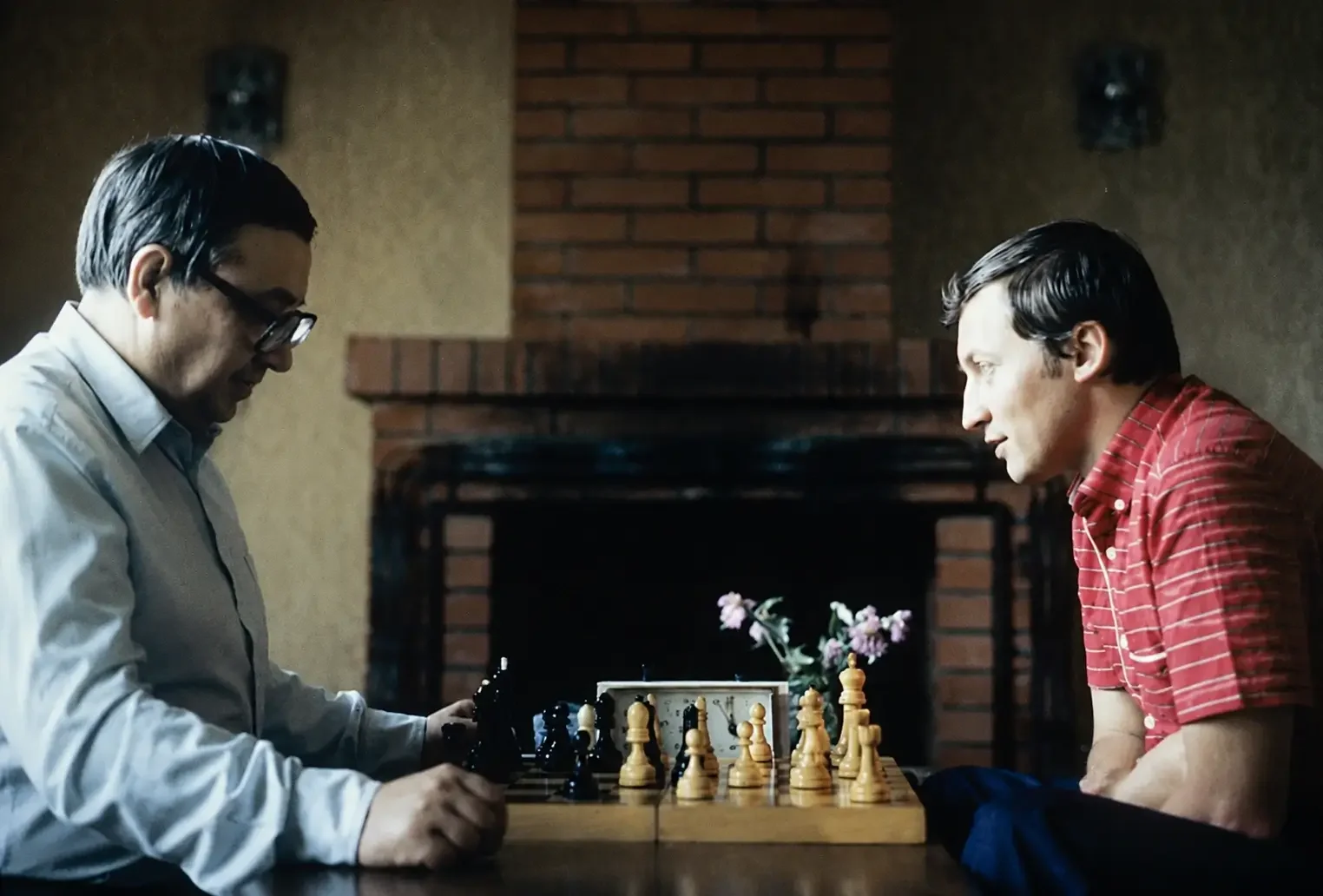
Igor Zaitsev and his student Anatoly Karpov
Introduction
Igor Arkadievich Zaitsev, Игорь Аркадьевич Зайцев, occupies an unusual place in chess history. He was a strong Soviet grandmaster in his own right, with a near miss in the 1968-69 USSR Championship, yet his durable historical significance rests even more on work that often remained partly invisible to the public: analytical preparation, opening invention, match seconding, chess journalism, philosophical writing, and teaching. Official Russian Chess Federation and FIDE profiles alike place him among the major Soviet and Russian analysts of the second half of the twentieth century, and FIDE’s own commemorative essays describe him as a “legendary coach, analyst, and trailblazer in chess opening theory.”
That combination of public achievement and backstage influence explains why Zaitsev deserves attention today. He was strong enough to win major events and defeat elite contemporaries, yet his deepest influence came through ideas transmitted through Petrosian, Polugaevsky, Karpov, Soviet national teams, and later generations of students and readers. Garry Kasparov, in the foreword to Attacking the Strongpoint, called him an “outstanding tactician and analyst” who “was able to see what no one else noticed,” while Mark Dvoretsky recalled preserving a special file of Zaitsev’s writings for students who needed help developing imagination and an unprejudiced approach to positions. Those are not ceremonial compliments. They describe the exact form of Zaitsev’s legacy.
Early Life and Chess Formation
Zaitsev was born in Ramenskoye, near Moscow. Russian Federation biographies state that he grew up there, finished secondary school with distinction, and later studied at the Moscow Institute of Transport Engineers. His family background was marked by wartime loss. His father, Arkady Aghaian, an Armenian and political officer on a Black Sea Fleet vessel, died at the end of the Second World War when the ship was mined; his mother, Anna Zaitseva, worked at the Red Banner textile factory in Ramenskoye. Later in life, Zaitsev’s own household remained closely linked to chess: his wife, Tamara Zaitseva, née Kasinova, became a correspondence grandmaster and master of sport.
The sources also suggest that Zaitsev developed late by Soviet elite standards. A 2025 FIDE veteran profile says he “began taking chess seriously only after graduating from university,” while Russian federation profiles emphasize his student years and his move to Moscow in 1963, where he started working for chess periodicals such as Shakhmatnaya Moskva, Shakhmaty v SSSR, and later 64. The exact sequence of studies and chess commitments is not perfectly uniform across sources, but they agree on the central point: Zaitsev was not presented as a prodigy. He entered the higher Soviet chess world through adult self-cultivation, journalism, and analytical labor as much as through conventional youth stardom.
For formative influence, Zaitsev’s own memoir Ryadom s Petrosyanom is especially valuable. He recalled attending sessions at the Central Chess Club on Gogolevsky Boulevard, where Tigran Petrosian’s lectures changed the chess understanding of a whole group of young Moscow masters and candidates. Zaitsev later wrote that many of them regarded Petrosian as a teacher in the deepest sense, even if Petrosian himself did not formally treat them as disciples. That testimony helps explain a recurring feature of Zaitsev’s later work: his thought remained grounded in concrete analysis, yet it was always tied to larger questions of positional meaning, strategic law, and chess aesthetics.
Rise in Competitive Chess
Zaitsev’s ascent as a tournament player was real and substantial. He appeared in six USSR Championships, in 1962, 1967, 1968-69, 1969, 1970, and 1991. His best result came in the 1968-69 Soviet Championship in Alma-Ata, where he tied for first and then lost the playoff for the title to Lev Polugaevsky, 3½-2½. In the Soviet context, that result was no small distinction. The USSR Championship was one of the hardest events in the world, and finishing in the top level placed Zaitsev in direct contact with the first rank of Soviet grandmasters. FIDE records list his International Master title in 1970 and Grandmaster title in 1976.
Several other achievements define the practical peak of his career. Russian Federation biographies credit him with winning the Moscow championship in 1969, taking silver in the Russian championship in 1973, and scoring first prizes in strong round robins at Moscow in 1968, Quito in 1977, Dubna in 1979, Bucharest in 1992, and Orel in 1993. He also remained dangerous enough over the board to defeat world champions such as Mikhail Tal and Boris Spassky, a point emphasized in official Russian profiles. The pattern is revealing: Zaitsev was not a short-lived flash, but a player whose competitive strength persisted across Soviet and post-Soviet decades even as his analytical and coaching work increasingly took center stage.
Major Career Achievements
The decisive turn in Zaitsev’s historical profile came when strong tournament results merged with high-level seconding. Russian Chess Federation biographies state that from 1971 to 1977, he worked with Tigran Petrosian and Lev Polugaevsky in Candidates competitions. FIDE’s 2025 veteran profile goes further, summarizing his record of service in 17 World Championship matches, including 7 title matches, and noting his late-1970s transition into Karpov’s camp after Semyon Furman's death in 1978. Kasparov’s foreword to Attacking the Strongpoint independently confirms that Zaitsev later became the leading trainer on Karpov’s team and accompanied him through seven World Championship matches. The convergence of those sources makes one conclusion hard to avoid: Zaitsev was not a peripheral helper. He was one of the principal analytical minds behind the Soviet world championship apparatus in the Karpov era.
His institutional standing matched that role. Russian Federation sources say he served as a senior trainer of victorious Soviet teams at the Olympiads, World Championships, and European Championships, for which he received the Order of Friendship of Peoples in 1981. After the Soviet period he continued to teach, worked abroad in several countries, and later held senior training roles connected with Moscow’s central chess institutions. In 2011, when he took charge of a new children’s school at the Central Chess Club, he described his aim as teaching young players to think independently, especially in the computer age. That commitment to disciplined autonomy, rather than simple dependence on prepared answers, fits naturally with the rest of his career.
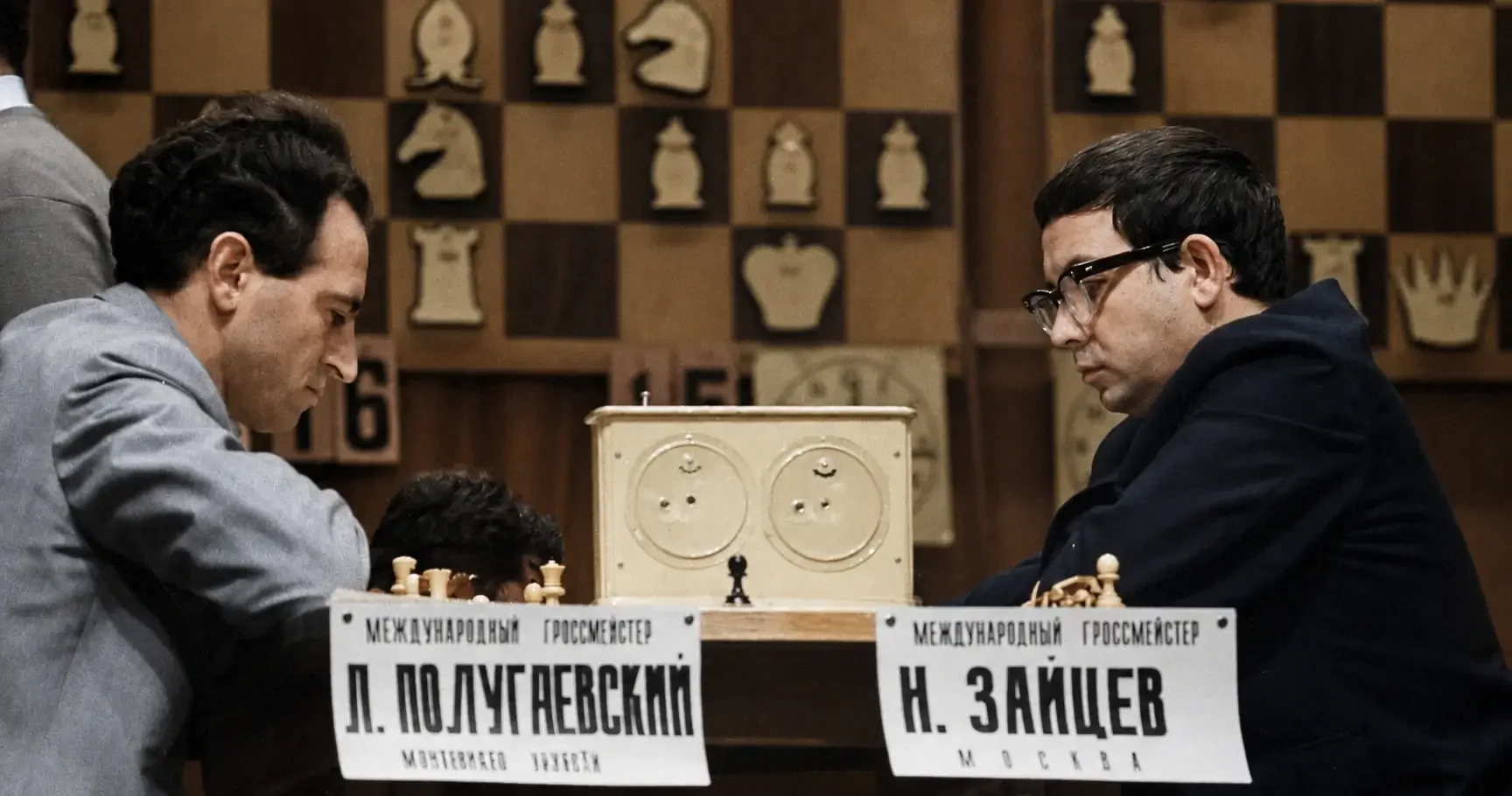
Lev Polugaevsky in play against Igor Zaitsev at the 37th USSR Chess Championship
Style and Reputation
Official Russian federation profiles describe Zaitsev as a player of bright, combinational style, and that formulation is supported by the testimony of leading contemporaries. Kasparov called him an outstanding tactician and analyst; Emil Sutovsky, writing for FIDE in 2023, portrayed him as a creator whose deepest gifts lay in invention rather than in relentless top-level practical grinding. That judgment should be read carefully. It does not diminish Zaitsev’s playing strength. It explains why his reputation grew even more in analytical contexts than in tournament standings. He had the imagination to produce difficult, dynamic ideas, and the Soviet chess world repeatedly trusted him to supply them in the most pressure-filled settings.
Kasparov’s recollection of their Baku 1980 game is especially telling. He described the encounter as an early lesson in “adult” opening preparation and singled out Zaitsev’s capacity to discover resources others missed. Russian Federation tributes by Anatoly Bykhovsky and Mark Dvoretsky add a second layer to this picture. Bykhovsky stressed that many world championship novelties could be traced back to Zaitsev, even though the secrecy of match preparation kept the public from seeing their true origins. Dvoretsky valued not only the opening finds, but also Zaitsev’s writings on middlegames and endgames, and remarked that he kept a separate folder of Zaitsev materials for his students. Together, these sources present Zaitsev as a chess thinker whose originality was recognized most clearly by other experts.
Contributions Beyond Tournament Play
Zaitsev’s name is attached permanently to the Zaitsev System in the Ruy Lopez, and official sources consistently identify that system as his most famous contribution to opening theory. Yet reducing him to that one line would understate the breadth of his work. Russian and FIDE profiles credit him with important analytical developments in the Spanish, Sicilian, King’s Indian, Caro-Kann, and other openings. Kasparov’s foreword likewise presents his opening legacy as much broader than the single eponymous system. The key historical point is not the technical detail of any one variation. It is that leading Soviet camps repeatedly depended on Zaitsev to generate fresh strategic and tactical resources in deeply analyzed positions before computers turned that labor into a different kind of enterprise.
He also contributed to chess culture as a journalist, essayist, memoirist, and philosophical writer. Federation biographies note his editorial work for Soviet chess publications and his many essays and memoir sketches. His own published memoir on Petrosian shows him as a reflective prose stylist, concerned with character, atmosphere, and the inner logic of chess understanding rather than with score sheets alone. The 2020 English edition of Attacking the Strongpoint makes this side of him visible in another form. Its table of contents includes not only strategic chapters but also essays on philosophy, autobiography, poetry, a portrait of Petrosian, and a bibliography of his articles. Zaitsev did not treat chess as a narrow technical profession. He treated it as an intellectual art with psychological and philosophical depth.
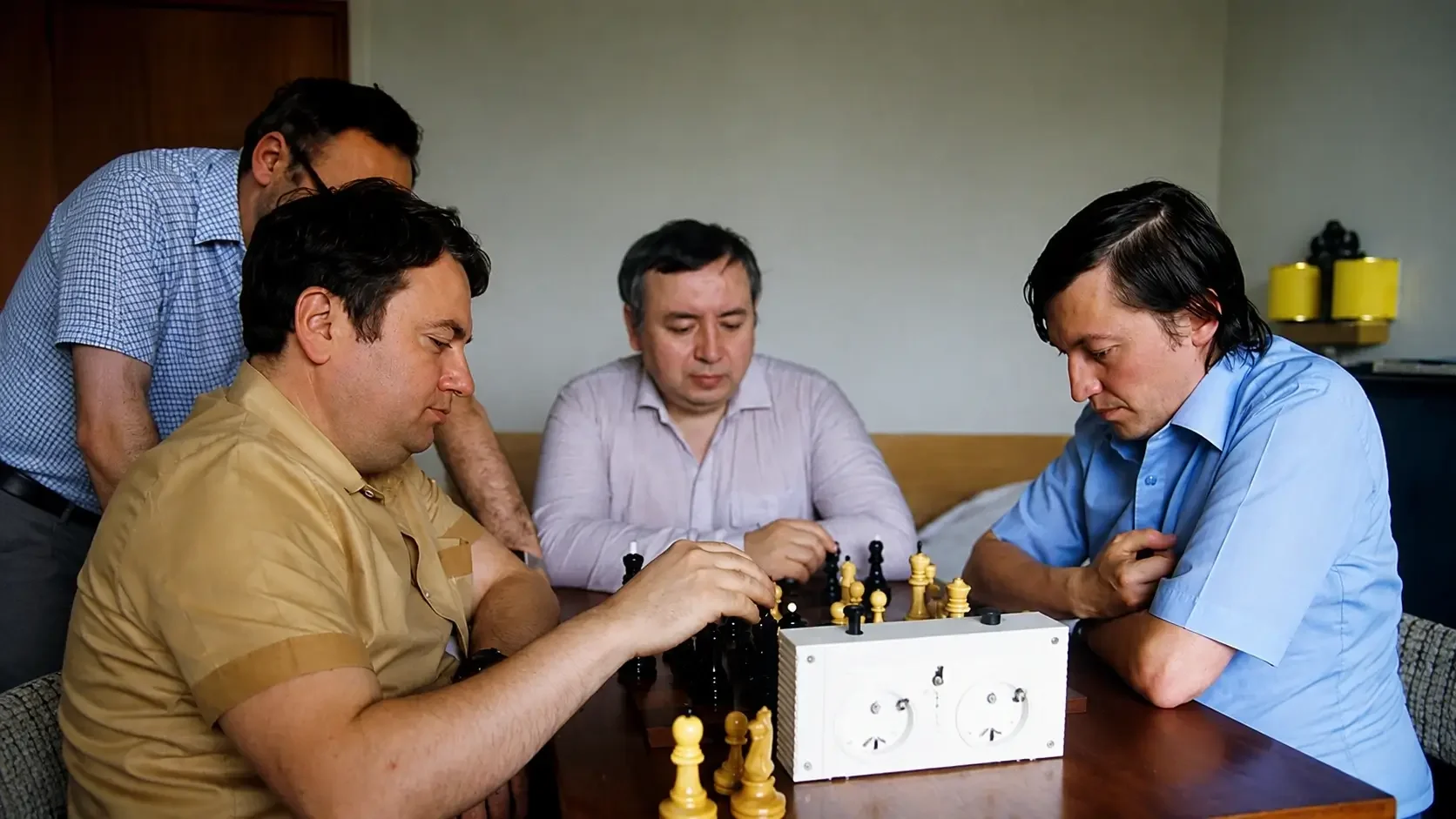
Left to right: Mikhail Podgaets, Igor Zaitsev, Anatoly Karpov
Historical Legacy
Later recognition confirmed what chess insiders had long understood. Zaitsev received the title of Honored Coach of the USSR, FIDE awarded him the title of Senior Trainer in 2006, the Russian Chess Federation awarded him its Golden Badge in 2022, and Russian chess institutions publicly noted his receipt of the Order of Honor in 2025 for his contribution to the development and popularization of chess. These honors summarize a life that crossed several historical phases: Soviet over-the-board competition, elite match preparation in the Petrosian and Karpov years, post-Soviet writing and training, and finally public recognition as one of the last living representatives of a distinctive pre-computer analytical culture.
Why does Igor Zaitsev deserve renewed attention now? Because he represents a form of chess excellence that standard tournament summaries rarely capture. He was a near Soviet champion, a grandmaster, a maker of durable opening ideas, a trusted second in world championship matches, a teacher who insisted on independent thought, and a writer who tried to describe chess as a field of reason, imagination, and art. Many strong players leave games; Zaitsev left methods, concepts, and intellectual habits. That is why his name continues to surface in the testimony of Karpov’s camp, Kasparov’s recollections, Dvoretsky’s pedagogy, and Russian federation memory. For serious readers of chess history, he is one of the clearest examples of how much of Soviet chess greatness was produced not only by champions on stage, but also by original thinkers just behind the curtain.
Notes and Sources
One factual point requires caution. Most Russian Federation biographies and FIDE commemorative articles give Zaitsev’s birth date as 27 May 1938, while the current FIDE rating profile lists only the birth year 1937. Because the fuller date, 27 May 1938, is repeated by multiple biographical profiles and memorial notices, this article follows that date while noting the discrepancy.
The most useful sources for this profile were official Russian Chess Federation biographical pages and interviews; FIDE’s player profile, veteran-support profile, and birthday tribute; OlimpBase records for the USSR Championships; Zaitsev’s own memoir Ryadom s Petrosyanom; and the preview materials for Attacking the Strongpoint, which preserve Kasparov’s foreword and the book’s structure. Together, these sources make it possible to reconstruct Zaitsev as a player, analyst, second, writer, and teacher without relying on anecdote or opening mythology alone.
