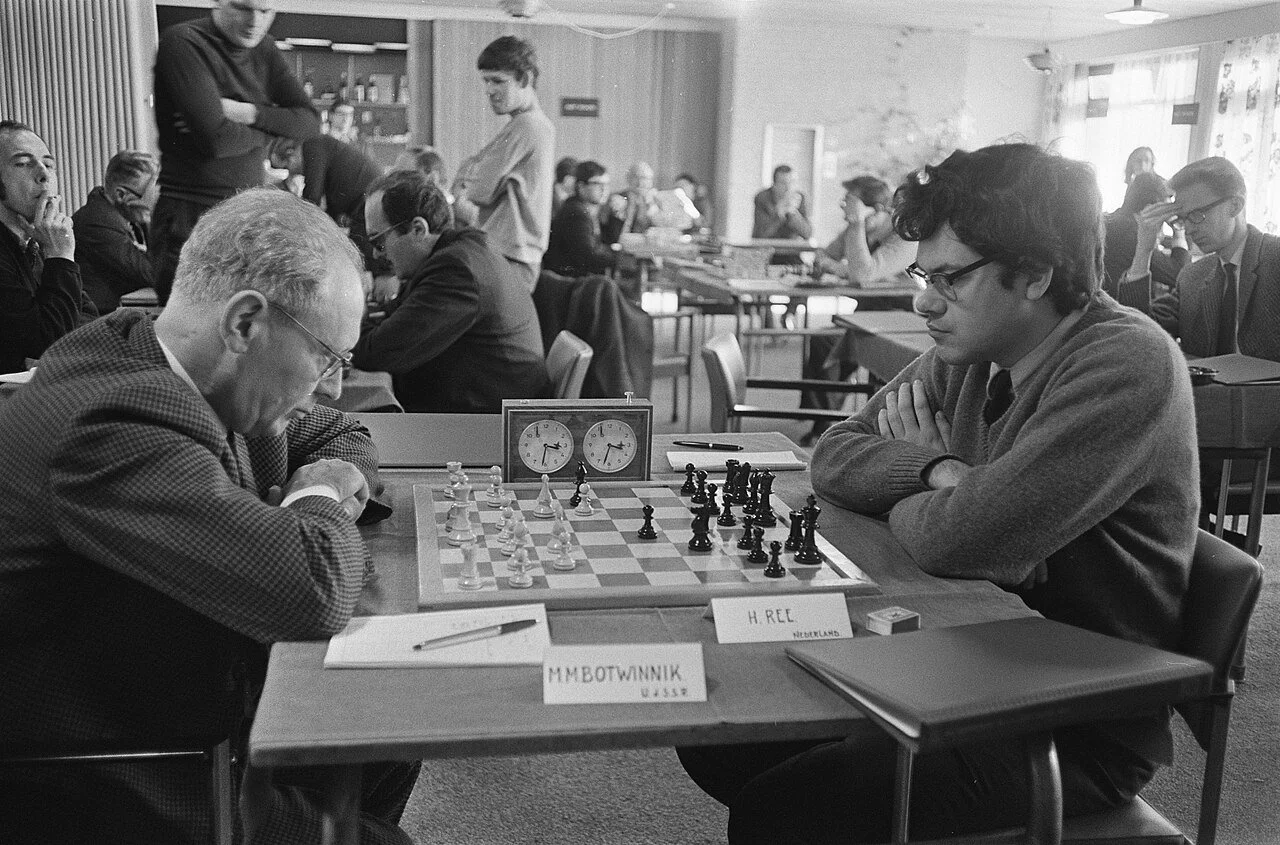
Botvinnik in play against Ree. Eric Koch for Anefo
Mikhail Botvinnik worked on a pocket chess set. Paul Keres sat at his bedside with a full-sized board. At the 1969 Hoogovens tournament in Wijk aan Zee, Botvinnik had fallen ill and still had an adjourned game to finish against Hungary’s Lajos Portisch. He could see a position in which his knight would give check just in time to stop a pawn. What he needed was a way to reach it. Keres found one. When play resumed, ten moves went by just as they had worked them out. The draw helped Botvinnik share first place with Efim Geller.1
A January festival on the Dutch coast
Play began on January 14. It was the thirty-first Hoogovens tournament and the second since the move from Beverwijk to the seaside village of Wijk aan Zee. About five hundred players were expected. Alongside the sixteen-player grandmaster group, the organizers had arranged a masters’ tournament, a women’s event, competitions for six student teams and smaller groups for amateurs. They moved the demonstration boards into a separate room where spectators could follow the games, freeing space in the playing halls. The playing rooms were now smoke-free.2
Botvinnik, Geller and Keres had each won Hoogovens before. Among the Dutch players were three-time national champion Jan Hein Donner and the reigning champion, Hans Ree. Ree drew Black against both Botvinnik and Geller. The two games were over in a combined 66 moves.3
Botvinnik gives up a rook for a bishop
Against Ree in round two, Botvinnik recognized an English Opening he had faced against Michael Basman at Hastings. He had got little from that earlier game. This time he played 7.Nd5, then drove the black bishop back with his b-pawn and brought both rooks and his queen onto the c-file. Ree had to defend the pawn on c7 while trying to stir up play against the white king.4
On move 25, Ree planted a bishop on c5. Botvinnik took it with a rook. After the recapture, White had given up the exchange, but Ree had lost the one piece Botvinnik considered active. His remaining rook eventually reached b7, and he had passed pawns on a5 and d6. Ree resigned at the time control. Botvinnik’s notes give the move he expected to seal, 41.Qc4, threatening the bishop on d7. The published game ends after Black’s fortieth move.4
Geller puts two rooks on the seventh rank
Geller had started by beating Portisch with White in a closed Ruy Lopez. A pawn exchange on c4 gave his rooks a way into Black’s position. Geller’s first rook took the pawn on c7 and then the one on f7. His second rook followed to c7. Even with the queens off, the two rooks had enough help against the king. When Geller brought his knight to g4, Portisch gave up a rook for it and resigned after the recapture. The following day Pál Benkő beat Geller. It was Geller’s only loss in fifteen games.5
When Ree sat down opposite Geller in round six, he lasted 26 moves. Geller’s queen entered on d6 as early as move 15. She withdrew to a3, leaving d6 for a knight, and soon a white bishop took the f7 pawn with check. Both white knights were still near the black king when Geller brought his queen back into the attack with 26.Qb3. Ree resigned. By the end of round seven, Geller and Keres had 5½ points each. Botvinnik led with 6.6
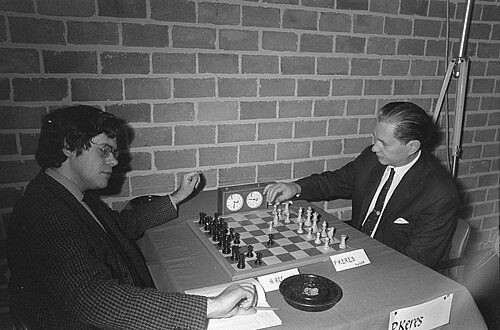
Jack de Nijs for Anefo
The knight maneuver Keres found
Portisch had followed his opening loss to Geller with another against Friðrik Ólafsson. He recovered so well that by round ten he could influence the lead himself. He gave Keres his only defeat of the tournament. Two rounds later he had White against Botvinnik and reached an ending in which his bishop could stop Black’s distant a-pawn while his king helped his own pawns forward.7
The position they had studied appeared on the board after Portisch’s 81.Bb3. Just seven men remained, including the kings. The white bishop kept Botvinnik’s a-pawn on a3. Portisch’s king stood on g5, ready to advance to f6 or g6. Keres’s idea was to allow it through. Botvinnik played 81...Nc6. After 82.Kg6 the knight returned to e7 with check, costing White a turn. Portisch tried 83.Kg7, the first departure from the analysis. Five moves later they agreed to a draw. Portisch had played 88 moves for the half-point.1
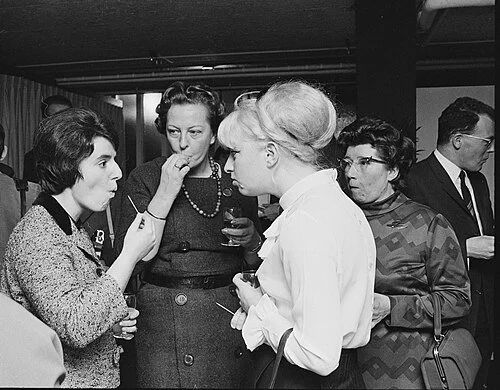
By Fotoburo De Boer - Noord-Hollands Archief, CC0
Nona Gaprindashvili in the masters’ group
Women’s world champion Nona Gaprindashvili entered the sixteen-player masters’ section. Back home, she told the Soviet weekly 64 that getting a good position could be the moment she lost concentration. Against Poland’s Jan Bednarski she declined a draw and then overlooked the loss of the exchange. After that game she stopped thinking about where she would finish. She scored six points from her last seven games to reach 7½ and share eighth place. Next came preparations for her world title match with Alla Kushnir.8
The two winners of the masters’ section both needed the last round. Hungary’s Károly Honfi led them by half a point going in. Heikki Westerinen of Finland beat Honfi with Black, and Yugoslavia’s Bojan Kurajica defeated Rob Hartoch. Westerinen and Kurajica finished on 11, Honfi on 10½. Romania’s Alexandra Nicolau won the women’s tournament with 8½ from eleven.9
The last morning at Wijk aan Zee
There was a practical reason for starting the last round at half past nine on Saturday, February 1. The traditional pea soup was due on the table at six, Donner explained in his newspaper column, and there would be no adjournments. He had been playing Dragoljub Ćirić for barely fifteen minutes when he offered a draw in French. Ćirić accepted. Within about an hour, five of the eight games had ended in draws.10
Geller took eighteen moves to draw with Lubomir Kavalek. Botvinnik took thirteen against Ólafsson. Both leaders now had 10½ from 15. Portisch was the one player who could still catch them, and he had White against Benkő. Their game went 35 moves before Benkő held the draw. At another board Keres, whose previous game against Predrag Ostojić had gone to 111 moves, beat Ree to join Portisch on 10.11
Botvinnik had won all six of his games against the players who finished eleventh through sixteenth. He drew with everyone else and went undefeated. Geller’s seven wins included victories over Portisch and Ólafsson, who finished fifth. Benkő, the only man to beat Geller, was also the man who kept Portisch from sharing the title.12
Notes
Mikhail Botvinnik, Botvinnik on the Endgame (Chess Enterprises, 1985), “Paul Keres’ Study,” chap. 23. The Soviet weekly printed the full game. Irina Mikhaylova reproduces Botvinnik’s explanation of the analysis. Botvinnik’s account in Mikhaylova, p. 6 · Portisch against Botvinnik in 64, p. 9.
“Hoogoventoernooi gaat nieuwe koers varen,” Het Rotterdamsch Parool, January 11, 1969, 9. The advance report describes the smaller competitions, the new demonstration room and the smoking rule. Svend O. v. Seelen dates the first round to January 14. Dutch tournament preview · Danish Chess Union tournament report · Tournament roll of honor and host towns.
Tata Steel Chess, historical winners. For Donner and Ree, see the Dutch Chess Federation’s register of Dutch champions. The round-by-round record identifies Ree’s three Soviet opponents. Hoogovens winners · Dutch champions · Wijk aan Zee game register.
Mikhail Botvinnik, annotations to Botvinnik–Ree, January 15, 1969, in Аналитические и критические работы, 1957–1970 (Fizkultura i Sport, 1986), translated by Douglas Griffin. Botvinnik’s notes and full game score.
Geller–Portisch, game 172, Шахматный бюллетень [Chess Bulletin], no. 4 (April 1969), 224. The tournament game register records Benkő’s second-round win. Original Soviet game score, p. 224 · Results by round.
“Пока в Алма-Ате чемпионат…” [While the championship is on in Alma-Ata], 64, no. 4 (1969), 5. The weekly printed Geller–Ree two issues later. Soviet report after seven rounds · Geller against Ree, p. 9.
Svend O. v. Seelen, report on the thirty-first Hoogovens tournament, Skakbladet, March 1969. The Danish report and the Soviet bulletin give the course of Portisch’s recovery and the grandmaster standings. Danish Chess Union report · Original Soviet crosstable, p. 228.
“Наши интервью” [Our interviews], interview with Nona Gaprindashvili, 64, no. 6 (February 7–13, 1969), 9. The interview and masters’ standings appear on the same page. Original Russian interview.
“Donner remise met Lombardy,” De Tijd, February 1, 1969, 4, and ANP, “Uitslagen en standen van Hoogovens,” Het Rotterdamsch Parool, February 3, 1969, 11. Standings before the last round · Final-round results in all three sections.
Jan Hein Donner, “Botwinnik en Geller maken remise-afspraak,” De Tijd, February 3, 1969, 16. Donner describes his own game and the traditional meal. De Telegraaf gives the starting time, and the Groningen daily records the early draws. Donner’s column · De Telegraaf, p. 17 · Nieuwsblad van het Noorden, p. 11.
“Donner remise met Lombardy,” De Tijd, February 1, 1969, 4. For the last-round pairings, results and game lengths, see the Dutch report and surviving scores. Keres’s 111-move draw and the standings · Dutch final-round report · Game lengths by round.
Final crosstable, Шахматный бюллетень, no. 4 (April 1969), 228. Tata Steel Chess lists both players as champions for 1969. Soviet crosstable · Organizer’s roll of honor.
