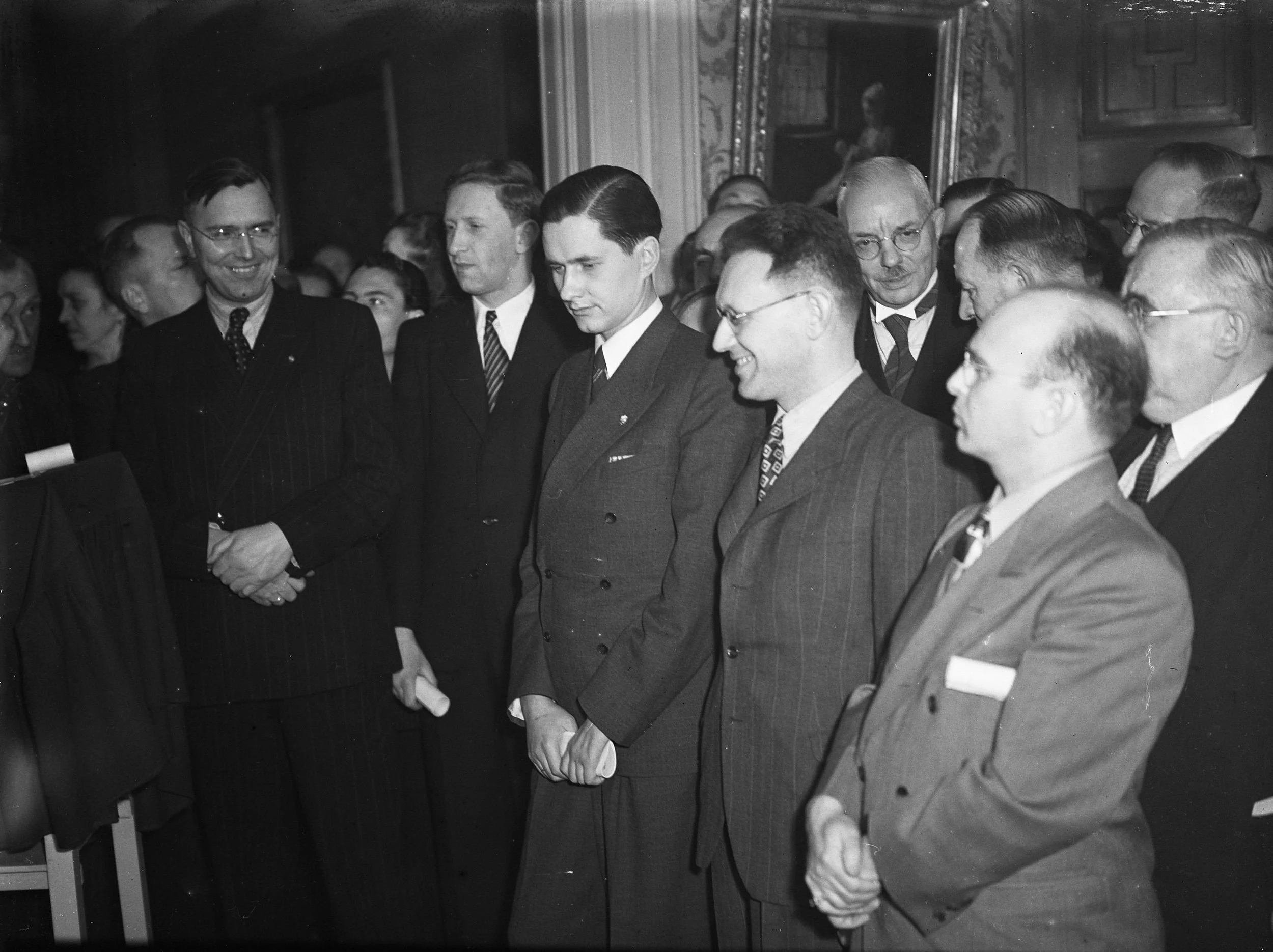
From left: Max Euwe, Vasily Smyslov, Paul Keres, Mikhail Botvinnik, and Samuel Reshevsky at the World Championship draw in The Hague, February 1948. Smyslov played twice for Moscow in Leningrad that September and won both games.
On the evening of September 16, 1948, Moscow and Leningrad sat down to play ten games of chess at the Leningrad Palace of Pioneers. Only one finished that night. Vyacheslav Ragozin won a piece against Alexander Tolush, who resigned. The other nine games were adjourned. Ragozin and his Moscow teammate Mikhail Yudovich later described the unusual sight of almost both full teams returning to finish a single match. Moscow won 6–4 to win the first Soviet team chess championship.[1][2]
How seven teams reached Leningrad
All sixteen Soviet republics entered. Moscow and Leningrad fielded city teams of their own, so there were three separate sides from the Russian republic. Four teams had places in the final from the outset. They were Moscow, Leningrad, the Russian Soviet Federative Socialist Republic (RSFSR) and the Ukrainian SSR. The other fourteen teams played for the three remaining places in June. Lithuania qualified in Riga, Georgia in Tbilisi and Uzbekistan in Frunze. Each finalist would meet the other six over ten boards, with the title decided by the total points scored in individual games.[2]
One board in every match was reserved for a woman. Elisaveta Bykova played all six games for Moscow. Leningrad divided the work between Lyudmila Rudenko and Kira Zvorykina. Bykova later devoted a page of her book Soviet Women Chess Players to the championship. She even recorded who led the women’s boards in each qualifying zone. In Riga, Latvia’s Milda Lauberte and Estonia’s Salme Rootare beat every opponent except each other. Their draw left them level on 3½ out of 4, although neither team qualified for Leningrad.[3]
Taimanov’s 16.Nb1 against Flohr
On board two, Mark Taimanov, who had studied chess at the Palace of Pioneers as a boy, had White against Salo Flohr. In a Caro-Kann Defense they exchanged queens on move twelve. Four moves later, Taimanov played 16.Nb1. The retreat looks peculiar until one follows the knight. It went through c3 and landed on b5, where it made it difficult for Flohr to contest the open d-file. Taimanov then walked his king from e2 to e3, f4, and e5. Flohr resigned after 54.a5.[4][5]
It was Leningrad’s only win in the match. Grigory Lisitsyn had played his last move of the first session openly, although he could have sealed it for the adjournment. The move lost a piece to Vladimir Simagin. Yuri Averbakh supplied Moscow’s third win against Viktor Vasiliev. The other six games ended in draws. Zvorykina took the only half-point Bykova conceded in the entire final. Moscow won 6–4.[1][3][4]
Ilivitsky and Taimanov on board two
Moscow had a bye on September 19. Leningrad had just beaten Ukraine 7–3 and could cut into the lead by beating the Russian SFSR. Taimanov faced Georgy Ilivitsky of Sverdlovsk on board two. He had already beaten Andor Lilienthal in the opening round. His game with Taimanov ended in a draw. Both men finished undefeated, Taimanov with 5 out of 6 and Ilivitsky with 4½.[2][6]
The Russian team won six of the other nine games. Isaac Boleslavsky beat Igor Bondarevsky on top board. Further down the order, Rashid Nezhmetdinov attacked Leonid Shamaev’s king, and T. Filanovskaya took the point from Rudenko in a pawn ending. The 6½–3½ defeat left Leningrad needing an extraordinary reversal on the last day.[6]
Six wins for Moscow and six for Geller
Averbakh went into the last round on September 21 with five wins from five games. Samuil Kotlerman of the Ukrainian SSR beat him in the first game to finish in their match. Ukraine’s Efim Geller collected his sixth consecutive win against Alexander Konstantinopolsky. Moscow still won the match 6–4. It finished on 40½ points out of 60, five clear of Leningrad. The Russian SFSR took third with 34. Ukraine, despite Geller’s perfect score, was fourth with 33.[7]
The October issue of Shakhmaty v SSSR put Moscow captain Grigory Ravinsky receiving the cup on its cover. Inside, the captains from the qualifying zones had requests for the organizers. Uzbekistan’s captain wanted masters to visit the Central Asian republics more regularly. Georgia’s reported that chess books and bulletins from Moscow reached local clubs irregularly and in small quantities. He also wanted the demonstration boards better placed so spectators could follow the play. The next championship took place in Tbilisi in 1951. This time the Russian SFSR won the cup.[8][4]
Notes
Vyacheslav Ragozin and Mikhail Yudovich, “Победа шахматистов Москвы” [Victory of the Moscow Chess Players], Шахматы в СССР, no. 10 (October 1948), 220–223. Both authors played for Moscow. Match report, p. 221 · Complete issue.
OlimpBase, “1st Soviet Team Chess Championship, Leningrad 1948,” format and qualification and final standings.
Elisaveta Bykova, Советские шахматистки [Soviet Women Chess Players], 2nd expanded ed. (Moscow: Fizkultura i Sport, 1957), 93. Original page with Bykova’s results · Digitized book. See also Moscow’s individual results.
V. Faibisovich, “Матчи титанов. 4-я серия” [Matches of the Titans, Part 4], January 31, 2005. Leningrad venue and Moscow match record. See also OlimpBase, round four, board by board.
Mark Taimanov, annotations to Taimanov–Flohr, game no. 185, Шахматы в СССР, no. 10 (October 1948), 226–227. Opening and knight maneuver, p. 226 · Conclusion, p. 227.
Ragozin and Yudovich, “Победа шахматистов Москвы,” 222. September 19 report. OlimpBase, sixth-round results, Russian SFSR scores and Leningrad scores. For Georgy Ilivitsky’s name and early career, see the Chess Federation of Russia profile.
OlimpBase, Moscow against the Ukrainian SSR and the Ukrainian team’s individual scores. Ragozin and Yudovich, final round and standings, p. 222.
“Говорят капитаны команд” [The Team Captains Speak], Шахматы в СССР, no. 10 (October 1948), p. 224 and p. 225. For the presentation of the cup, see the front cover and its original caption.


