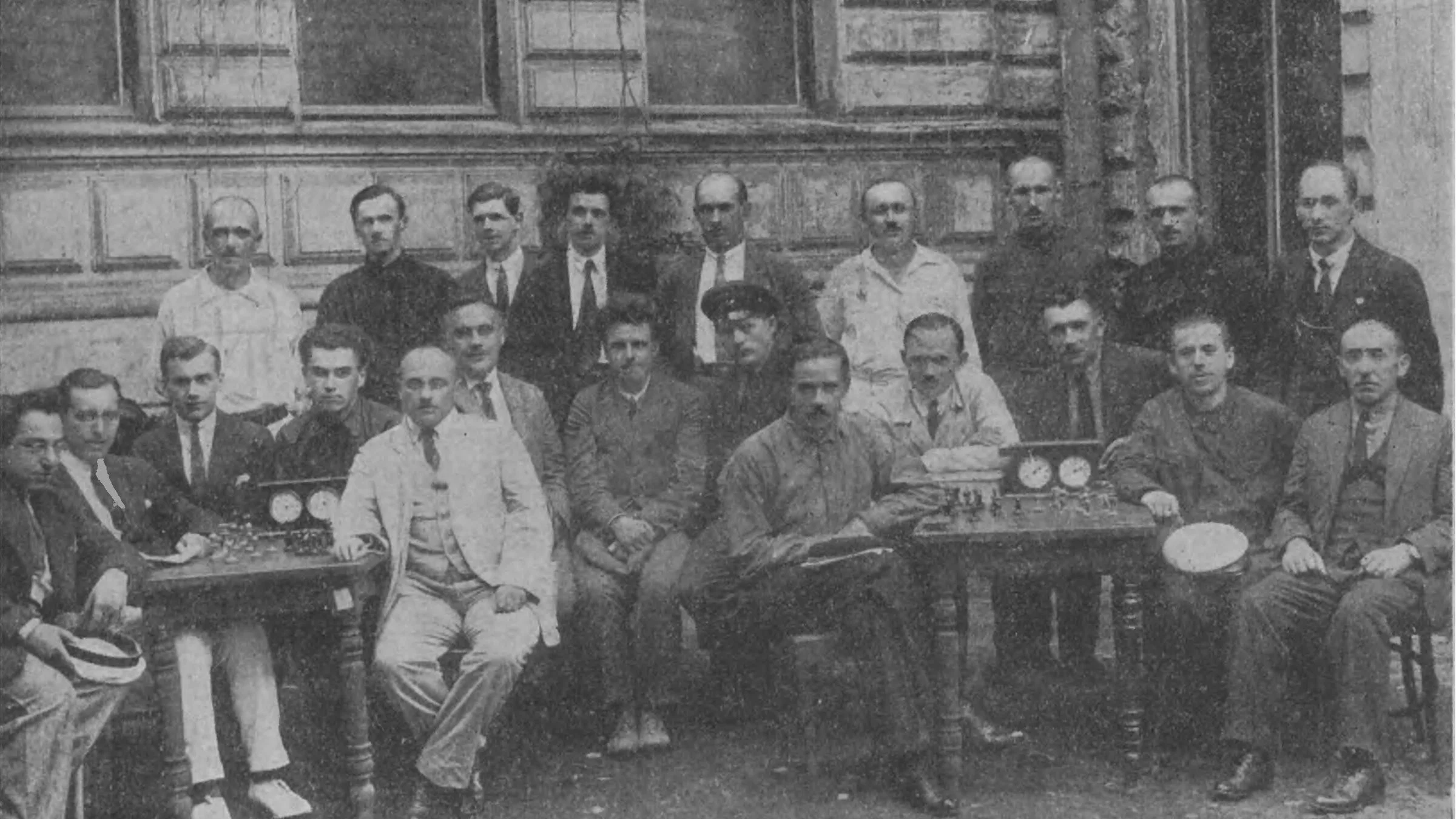
Players and organizers at the fourth USSR Chess Championship, Leningrad, 1925. In the seated row, Grigory Levenfish is second from the left, Ilya Rabinovich fifth, and Efim Bogoljubow sixth. Photographer unknown. Шахматы и шашки в рабочем клубе «64», nos. 17–18 (1925), p. 3. Public domain. Cropped.
Alexander Alekhine won the first Soviet chess championship two years before the Soviet Union existed. In October 1920 he won nine games and drew six in the sixteen-player main event of Moscow’s All-Russian Chess Olympiad. Soviet chess histories counted that tournament as the first in a series of 58. The last title went to Artashes Minasian, also in Moscow, in November 1991. [1] [2]
An invitation on a Kiev street
In Kiev, Fedor Bohatyrchuk learned of his invitation to Moscow from a notice posted on Khreshchatyk. In his memoir he recalled a sports official telling him that Alekhine would play and offering him 15,000 rubles for the journey. He accepted. On his way home, he began to wonder how he would get back to his family if Kiev changed hands again. His wife reminded him that he was still recovering from typhus. They decided he would stay in Kiev. [1]
Alexander Ilyin-Zhenevsky, who persuaded the military training authorities to include chess in their plans for a sports Olympiad, played in the Moscow tournament himself. Pyotr Romanovsky, the runner-up, remembered players going to the market to trade bread for cigarettes. Seven years later, Romanovsky and Bohatyrchuk shared the 1927 title in Moscow. [1] [2]
The players in the Leningrad photograph
The 1925 championship took place at the House of Scientists on the Neva, in the former palace of Grand Duke Vladimir Alexandrovich. The chess journal 64 reported that only the busiest days drew crowds like those in Moscow the year before. Efim Bogoljubow defended his title with 14 points from 19 games. Grigory Levenfish finished one point behind him, and Ilya Rabinovich took third. [3]
Boris Verlinsky, seated second from the right in the photograph, finished fourth despite beating all three men above him. His win over Bogoljubow earned a brilliancy prize. Verlinsky won his own Soviet title in Odessa in 1929. Levenfish and Rabinovich shared the 1934–35 championship in Leningrad, and Levenfish won outright in Tbilisi in 1937. [2] [3]
Botvinnik, Tal and the six-title record
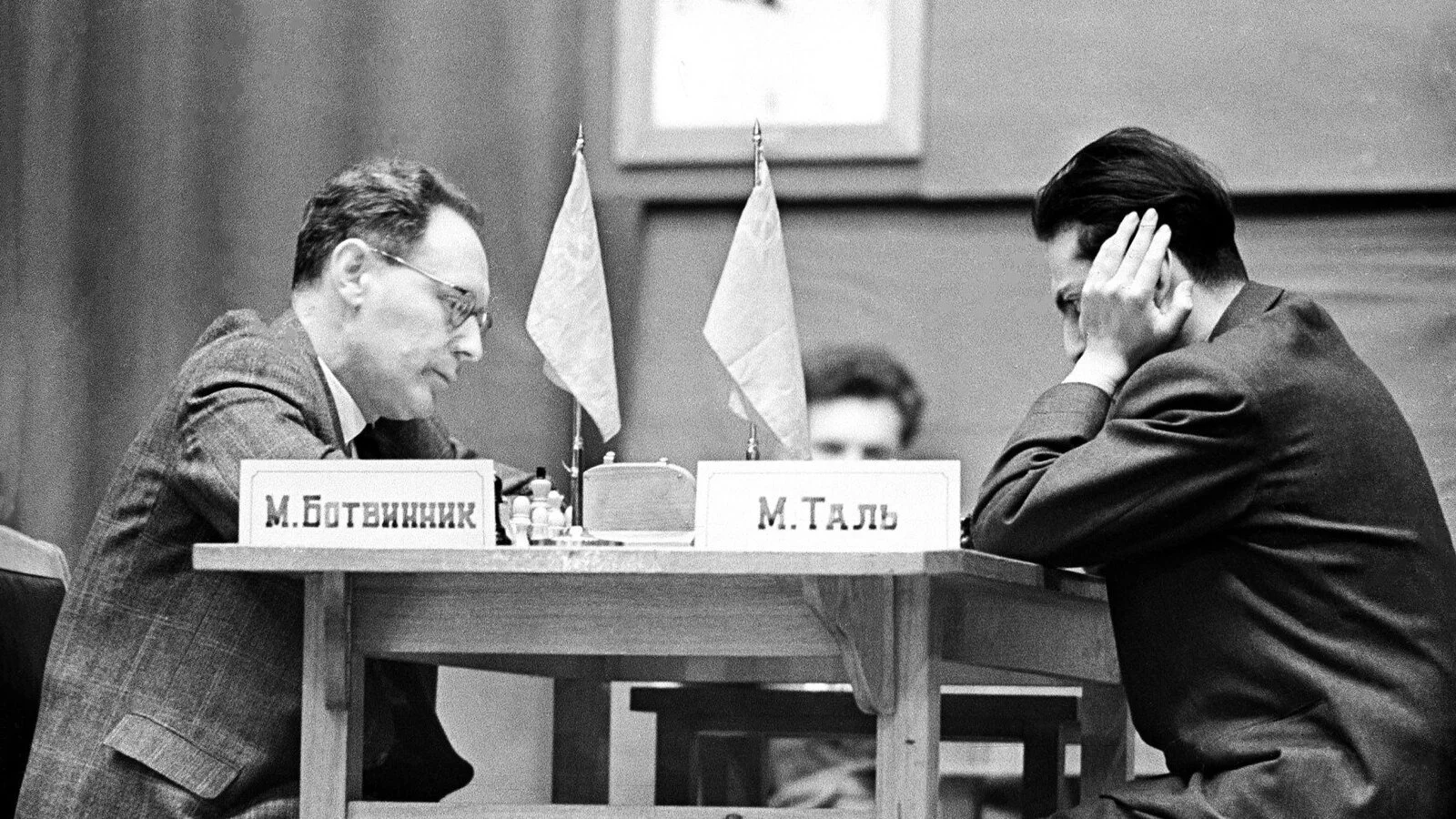
Mikhail Botvinnik and Mikhail Tal during the fourth game of their World Championship match, Moscow, March 22, 1960. Each won six Soviet championships. A. Batanov / Main Archive of Moscow (Главархив Москвы). Cropped.
Mikhail Botvinnik was twenty when he won the Soviet championship in Moscow in 1931. It was the first of his six numbered titles. He also won the separate Absolute Championship in 1941. The top six finishers from the 1940 final, where Igor Bondarevsky and Andor Lilienthal had shared first, met in Leningrad and Moscow. Each played the other five four times. Botvinnik scored 13½ out of 20, ahead of Paul Keres. The numbered series resumed with the thirteenth championship in Moscow in 1944. [2] [4]
Botvinnik had to play Mark Taimanov six more times to secure his last title. They tied in Moscow in December 1952, and Botvinnik won their playoff the following year, 3½–2½. In Leningrad in 1956, Taimanov reached another playoff, this time with Yuri Averbakh and Boris Spassky. He drew both games with Averbakh and beat Spassky twice to win his only Soviet championship. [5]
Mikhail Tal equaled Botvinnik’s record. He won outright in Moscow in 1957, Riga in 1958 and Baku in 1972. He shared the title with Lev Polugaevsky in Kharkov in 1967, Alexander Beliavsky in Leningrad in 1974 and Vitaly Tseshkovsky in Tbilisi in 1978. [2] [8]
Qualifying for the Soviet final
Efim Geller once won a championship quarterfinal with 12 points from 15 games, then went out in the semifinal. When he reached his first final in 1949, he led going into the last round. A loss to Ratmir Kholmov left him with a bronze medal. Geller won his first title in 1955 by beating Vasily Smyslov in a playoff. He won again in Minsk in 1979, in a field that included sixteen-year-old Garry Kasparov. [6]
For the 1958 final in Riga, sixty players competed in three semifinals of twenty. Tigran Petrosian finished ahead of Geller in Kiev. Spassky and Alexander Tolush shared first in Leningrad, and Viktor Korchnoi won in Sverdlovsk. Of the nineteen who played in Riga, six came from the Kiev semifinal, five from Leningrad and six from Sverdlovsk. The other two were Tal, the defending champion, and David Bronstein. Four places at the Portorož Interzonal were at stake. [6] [7]
Spassky had White against Tal in the last round. They adjourned after move 45. Spassky later recalled declining Tal’s draw offer, then offering a draw himself as his position worsened. Tal played on and won. He retained the title in his home city with 12½ out of 18 and went on to win at Portorož. Spassky missed qualification. [7]
How a tie for first was settled
Three consecutive Soviet championships ended with Lev Polugaevsky tied for first. In Kharkov in 1967, more than a hundred players contested a thirteen-round Swiss. Polugaevsky and Tal scored 10 points each and shared the title. In the next championship, at Alma-Ata, Polugaevsky tied with Alexander Zaitsev and won their six-game playoff in Vladimir. In Moscow in 1969 he tied with Tigran Petrosian. Petrosian won the playoff. [8]
At Riga in 1985, Mikhail Gurevich, Viktor Gavrikov and Alexander Chernin finished on 11 points from 19 games. They met again in Vilnius that December, where each played the other two twice. All six games ended in draws. The Soviet chess bulletin reported that Gurevich received first place on the strength of his tiebreak score from Riga. [9]
In Moscow in 1988, Garry Kasparov and Anatoly Karpov each scored 11½ out of 17 without losing a game. The regulations called for a four-game match. Kasparov wanted play to continue to the first win if the score reached 2–2. Karpov wanted a four-game limit. On October 22 the Soviet Chess Federation voted unanimously to dispense with the match and award the title to both men. [10]
In Leningrad in 1990, Alexander Beliavsky, Leonid Yudasin, Evgeny Bareev and Alexey Vyzmanavin all scored 8½ out of 13. Each received 3,500 rubles. The published rules awarded the championship on the Berger tiebreak. Beliavsky placed first and won his fourth Soviet title. [11]
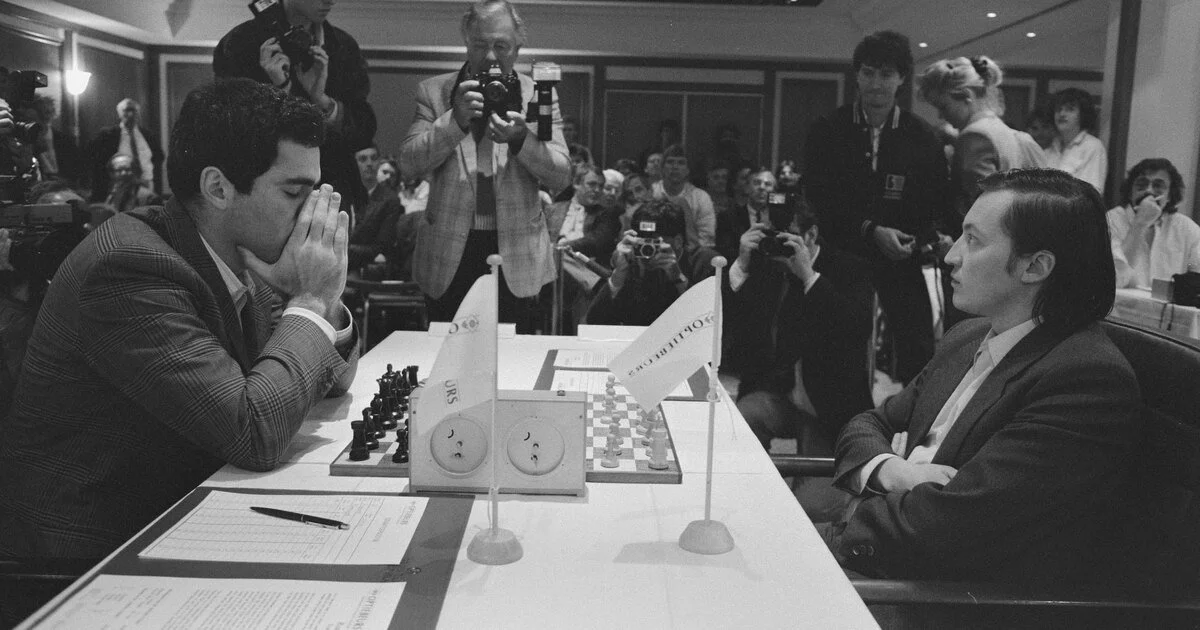
Garry Kasparov and Anatoly Karpov at the Optiebeurs tournament in Amsterdam on May 19, 1988. Later that year, they shared the Soviet title in Moscow. Rob C. Croes / Anefo, Nationaal Archief, no. 934-2524. Cropped.
The last Soviet champion
Sixty-four players contested the last USSR Chess Championship in Moscow in November 1991. After losing to Elmar Magerramov in round eight, Artashes Minasian thought his chance of first place had gone. Before the final round, he walked around Moscow with friends and tried to keep his mind off chess. He then beat Andrei Kharlov with Black. Minasian and the undefeated Magerramov both finished with 8½ points from 11 games. [12]
Immediately after the closing ceremony on November 13, the magazine 64 interviewed both players. Its correspondent identified the average rating of their opponents as the deciding tiebreak. The magazine’s standings gave that figure as 2565 for Minasian and 2516 for Magerramov. Minasian took the last Soviet title. [12]
Winners of all 58 USSR Chess Championships
Across 58 numbered championships, 35 players held the title. Twelve editions produced joint champions. The list gives the host city of each final, with both years shown when play continued into January. The separate USSR Women’s Chess Championship began in Moscow in 1927. Olga Rubtsova won its first edition. [2]
1920s
1920, Moscow. Alexander Alekhine.
1923, Petrograd. Pyotr Romanovsky.
1924, Moscow. Efim Bogoljubow.
1925, Leningrad. Efim Bogoljubow.
1927, Moscow. Fedor Bohatyrchuk and Pyotr Romanovsky.
1929, Odessa. Boris Verlinsky.
1930s
1931, Moscow. Mikhail Botvinnik.
1933, Leningrad. Mikhail Botvinnik.
1934–35, Leningrad. Grigory Levenfish and Ilya Rabinovich.
1937, Tbilisi. Grigory Levenfish.
1939, Leningrad. Mikhail Botvinnik.
1940s
1940, Moscow. Igor Bondarevsky and Andor Lilienthal.
1944, Moscow. Mikhail Botvinnik.
1945, Moscow. Mikhail Botvinnik.
1947, Leningrad. Paul Keres.
1948, Moscow. David Bronstein and Alexander Kotov.
1949, Moscow. David Bronstein and Vasily Smyslov.
1950s
1950, Moscow. Paul Keres.
1951, Moscow. Paul Keres.
1952, Moscow. Mikhail Botvinnik.
1954, Kiev. Yuri Averbakh.
1955, Moscow. Efim Geller.
1956, Leningrad. Mark Taimanov.
1957, Moscow. Mikhail Tal.
1958, Riga. Mikhail Tal.
1959, Tbilisi. Tigran Petrosian.
1960s
1960, Leningrad. Viktor Korchnoi.
1961, Moscow. Tigran Petrosian.
1961, Baku. Boris Spassky.
1962, Yerevan. Viktor Korchnoi.
1963, Leningrad. Leonid Stein.
1964–65, Kiev. Viktor Korchnoi.
1965, Tallinn. Leonid Stein.
1966–67, Tbilisi. Leonid Stein.
1967, Kharkov. Lev Polugaevsky and Mikhail Tal.
1968–69, Alma-Ata. Lev Polugaevsky.
1969, Moscow. Tigran Petrosian.
1970s
1970, Riga. Viktor Korchnoi.
1971, Leningrad. Vladimir Savon.
1972, Baku. Mikhail Tal.
1973, Moscow. Boris Spassky.
1974, Leningrad. Alexander Beliavsky and Mikhail Tal.
1975, Yerevan. Tigran Petrosian.
1976, Moscow. Anatoly Karpov.
1977, Leningrad. Boris Gulko and Iosif Dorfman.
1978, Tbilisi. Mikhail Tal and Vitaly Tseshkovsky.
1979, Minsk. Efim Geller.
1980s
1980–81, Vilnius. Alexander Beliavsky and Lev Psakhis.
1981, Frunze. Garry Kasparov and Lev Psakhis.
1983, Moscow. Anatoly Karpov.
1984, Lvov (Lviv). Andrei Sokolov.
1985, Riga. Mikhail Gurevich.
1986, Kiev. Vitaly Tseshkovsky.
1987, Minsk. Alexander Beliavsky.
1988, Moscow. Anatoly Karpov and Garry Kasparov.
1989, Odessa. Rafael Vaganian.
1990s
1990, Leningrad. Alexander Beliavsky.
1991, Moscow. Artashes Minasian.
Championships in the archive
Notes
Sergey Voronkov, Masterpieces and Dramas of the Soviet Championships, vol. 1, 1920–1937 (Elk and Ruby, 2020), opening chapter. Voronkov reproduces the recollections of Bohatyrchuk, Ilyin-Zhenevsky and Romanovsky. See also E. V. Demchik and A. S. Gorovoy, “Шахматный спорт в первые годы советской власти,” История и современное мировоззрение 4, no. 2 (2022), 32–38. Voronkov’s Russian text · English chapter excerpt · Journal article · Moscow 1920 results.
Bernard Cafferty and Mark Taimanov, The Soviet Championships (London, Cadogan, 1998). The register counts formal title awards, including shared titles. Playoffs appear under the edition that produced the tie. The 1941 Absolute Championship has its own entry in the tournament records. Berlin State Library catalogue · Numbered championships and playoffs · Women’s championship register.
“Всесоюзный чемпионат СССР 1925 г.,” Шахматы и шашки в рабочем клубе «64», nos. 17–18 (September 30, 1925), 3–6. The original caption names the seated players from left to right on page 3. The crosstable and the awards for individual games appear on page 6. Voronkov also reproduces the journal’s August description of the venue. Group photograph and caption · Crosstable and prizes · Contemporary description of the palace.
Sergey Voronkov, “1941 год. Матч-турнир на звание абсолютного чемпиона СССР,” ChessPro, with Botvinnik’s recollection of the arrangements. The match-tournament record gives all six players’ scores. Voronkov’s account · Moscow 1940 · 1941 Absolute Championship.
“60 лет Тайманову,” Шахматный бюллетень, no. 3 (March 1986), 29. The playoff records give the individual results against Botvinnik, Averbakh and Spassky. Soviet bulletin · Moscow playoff, 1953 · Leningrad playoff, 1956.
Chess Federation of Russia, “Ефим Геллер,” on Geller’s quarterfinal score, his debut in the 1949 final and his two national titles. The semifinal and final crosstables distinguish qualifiers from players who actually appeared in Riga. Lev Aronin qualified in Leningrad and missed the final. Georgy Borisenko finished sixth in Sverdlovsk and played in Riga. Federation biography · Kiev semifinal · Leningrad semifinal · Sverdlovsk semifinal.
The Riga tournament record gives the final-round pairings and the four qualifying places. Leonard Barden recounts Spassky’s description of the adjournment and draw offers in his obituary of Spassky, The Guardian, February 28, 2025. Riga results and rounds · Spassky’s recollection · Portorož Interzonal standings.
“XXXV чемпионат СССР,” Шахматный бюллетень, no. 2 (February 1968), 38–42, publishes games from Kharkov. The Chess Federation of Russia’s biography of Lev Polugaevsky describes his three consecutive ties for first and the playoffs against Zaitsev and Petrosian. Federation biography · Contemporary Kharkov bulletin · Kharkov standings · Playoff with Zaitsev · Tbilisi 1978.
“Матч-турнир на звание чемпиона СССР,” Шахматный бюллетень, no. 3 (March 1986), 12. The report gives all six games and says that Gurevich received first place on his tiebreak from the championship. Playoff report and game scores · Riga standings.
“Официальное досье к дополнительному матчу,” 64. Шахматное обозрение, no. 19 (October 1988), 2–4. The federation’s final resolution, adopted unanimously on October 22, was published in no. 22 (November 1988). The last paragraph of the resolution awards the title to both players. Playoff correspondence · October 22 resolution · Moscow standings.
“Дележка по-питерски,” 64. Шахматное обозрение, no. 23 (December 1990). The report gives the prize money, names the four leaders in Berger order and congratulates Beliavsky on his fourth title. Original report and crosstable · Leningrad standings.
Vadim Ostrovsky, interviews with Artashes Minasian and Elmar Magerramov, 64. Шахматное обозрение, nos. 23–24 (December 1991), 16–19. On page 18 Ostrovsky identifies average opponent rating as the deciding tiebreak. The standings on page 19 give the two averages. OlimpBase lists Buchholz first in its retrospective account. The description here follows the contemporary interviews and results. Minasian’s interview · Magerramov on the tiebreak · Original standings · Round-by-round results.
